US stocks churned higher and set fresh 2026 highs before flattening out last week. Gold, the energy index, and one of the hedge fund ETFs gave back a chunk of the spring's gains. Bitcoin and bonds stayed quiet.
The 2-Minute Version
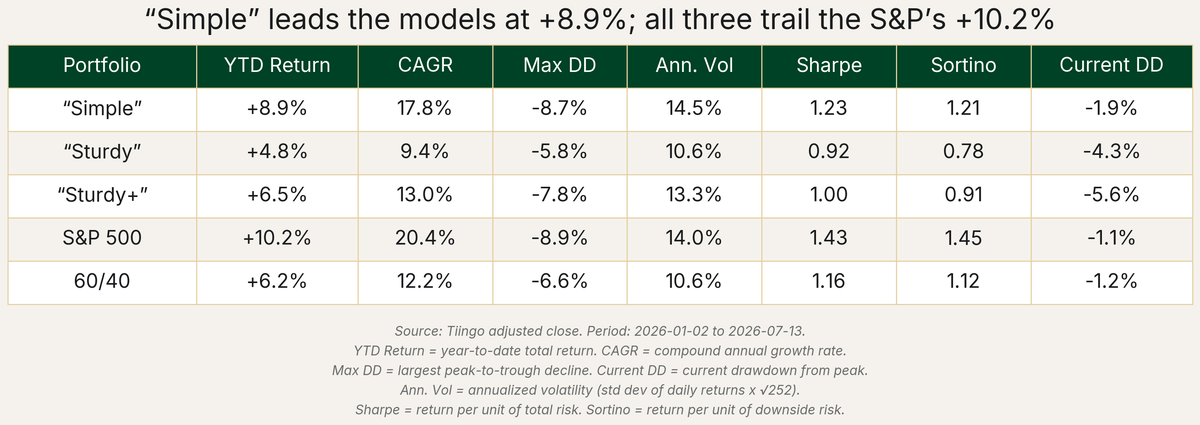
- Simple leads our models at +8.9% YTD, still trailing the S&P 500's +10.2%. It also now carries the best risk-adjusted return of the three (Sharpe of 1.23, Sharpe Ratio is a measure of return per unit of risk).
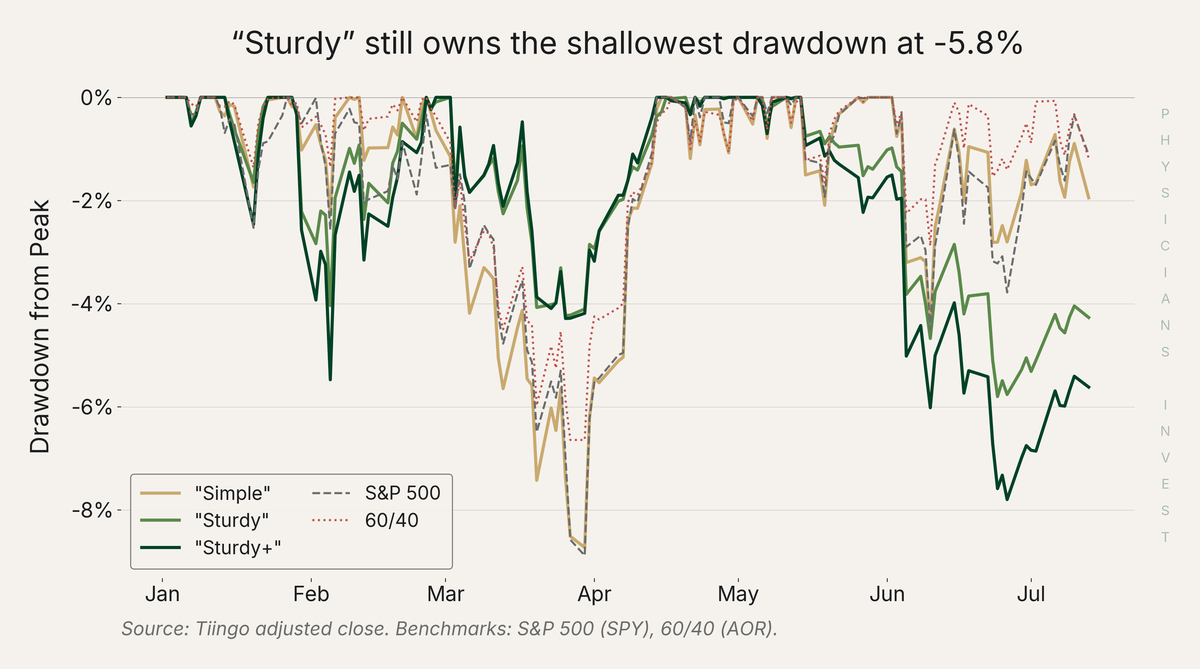
- Sturdy has had the smoothest ride. Its worst drawdown (its biggest peak-to-trough drop) is -5.8%, about two-thirds of the S&P 500's -8.9% drawdown from earlier in the year. This portfolio sits at +4.8% YTD.
- Sturdy+ has returned +6.5% YTD after its gold and hedge fund holdings pulled back this month.
- Two tax moves: investors who harvested IBIT into GBTC in June are past the 31-day wash-sale window and can rotate back to IBIT, and gold (GLDM) is a fresh harvest candidate at -7.7% YTD.
Market Context
The past month was a grind higher for US stocks, with the S&P 500 setting new 2026 highs before flattening out last week. International stocks rose but lagged US markets. The damage this month came from the diversifiers: gold (GLDM) fell about 7% over the past month and CTA, one of the hedge fund holdings, dropped 8%. These are the drivers behind Simple being up on the month while Sturdy and Sturdy+ each slipped about half a percent.
Energy gave back a little but is still up 26% on the year. We think continued uncertainty around the Strait of Hormuz could keep energy prices propped up. Bitcoin stopped falling and was flat, although it remains down 31% year-to-date. Bonds were quiet again, as they have been all year.
This month there are two tax moves:
- Investors who executed a tax loss harvest into GBTC in June can swap back into IBIT now that the 31-day window has passed.
- A new harvest opportunity in gold has presented itself. The mechanics of this are covered in the portfolio sections.
Other than tax loss harvesting, there are no changes to any of the portfolios this month.
Performance Dashboard
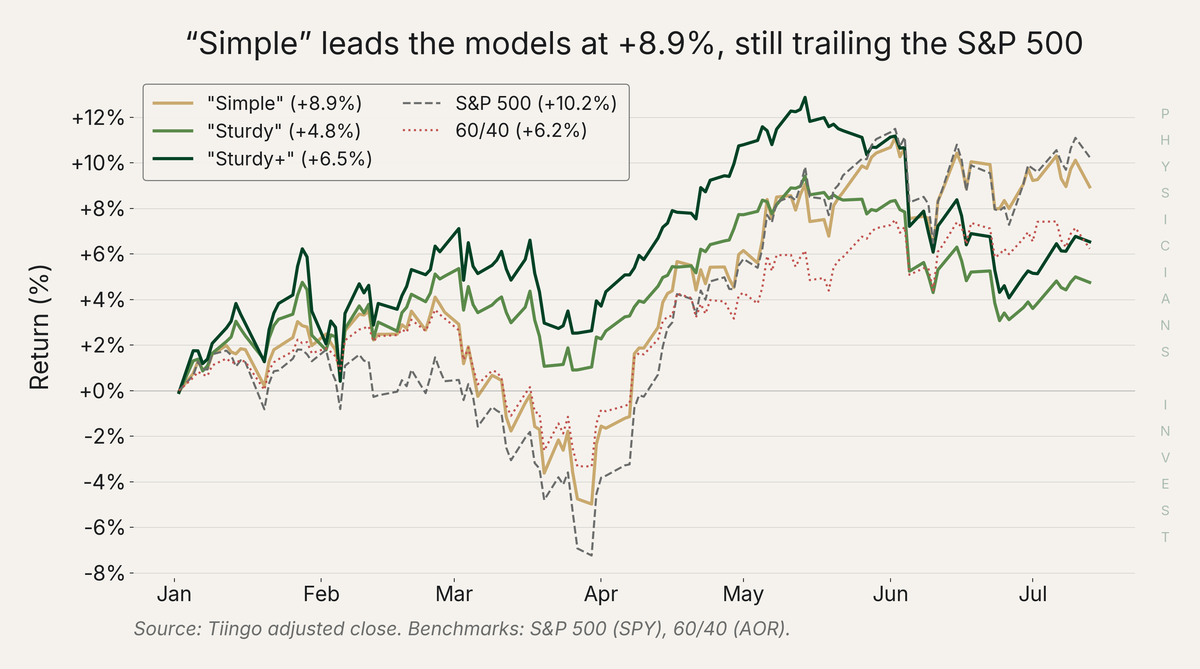 Source: Physicians Invest model portfolio. Hypothetical $100K, not actual returns.
1. "Simple" Portfolio
For: Residents and early-career physicians who want a "set it and forget it" approach.
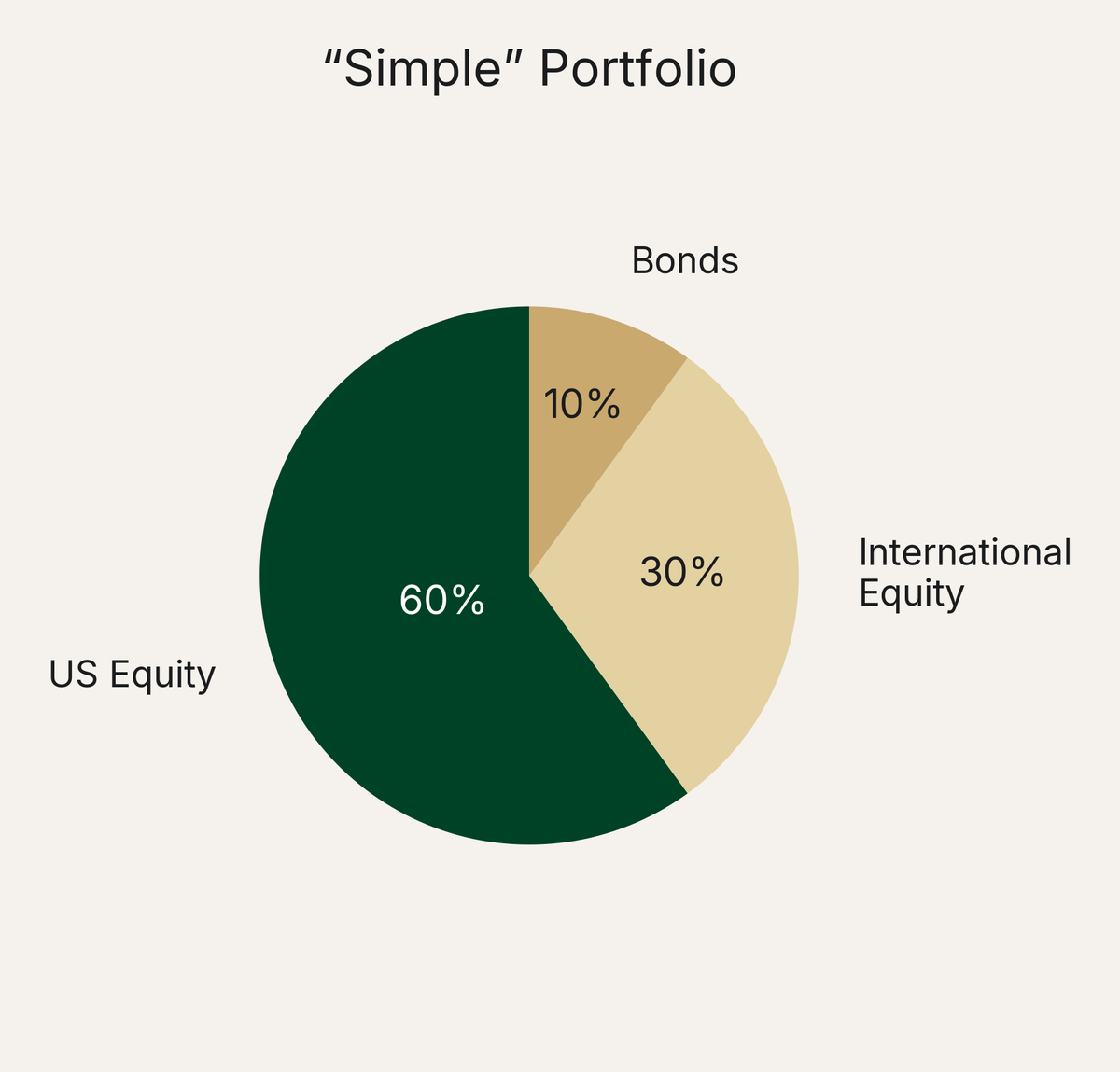
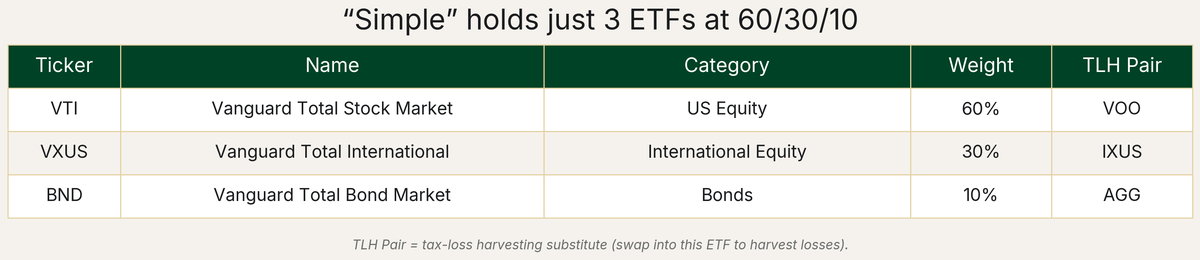
Strategy: Three ETFs at 60/30/10. Beauty in simplicity.
Advantages: Lowest expense ratios in the lineup (under 0.05% blended; expense ratio is the annual fee an ETF charges, expressed as a percent of assets). Easy to rebalance with three line items. Doesn’t hold any exotic holdings.
Disadvantages: Concentrated in stocks and bonds. When both go down together (like Q1 2026), there is nowhere to hide. Diversifies with two assets but does not perform well when interest rates are increasing (2022).
Tax-Advantaged Tweak: In a Roth or 401(k), investors who want real-estate exposure could add a 5-10% REIT (real estate investment trust) slice carved from US equity (VNQ is one common ETF to use for this). REITs throw off ordinary income that gets taxed at the marginal rate in a taxable account so it should be kept in tax-protected accounts only.
What Changed
No changes this month. The Simple portfolio is designed for long-term holding with minimal intervention.
Tax Loss Harvesting Opportunities
One holding is slightly underwater YTD:
- BND (Total Bond Market): started the year around $73, and its price is now about 1.1% lower, a small unrealized loss on shares bought then. The tax-loss harvesting substitute is AGG. At a loss this small, most investors will find it isn't worth the transaction friction.
Mechanics of TLH: Tax-loss harvesting means selling a position at a loss to bank that loss against future gains (or up to $3,000 of ordinary income a year), then buying a near-identical fund to stay invested. Harvesting actions mean the wash-sale rule applies: the same fund cannot be repurchased within 31 days.
2. "Sturdy" Portfolio
For: Mid-career attendings who want a smoother ride without giving up long-term return.
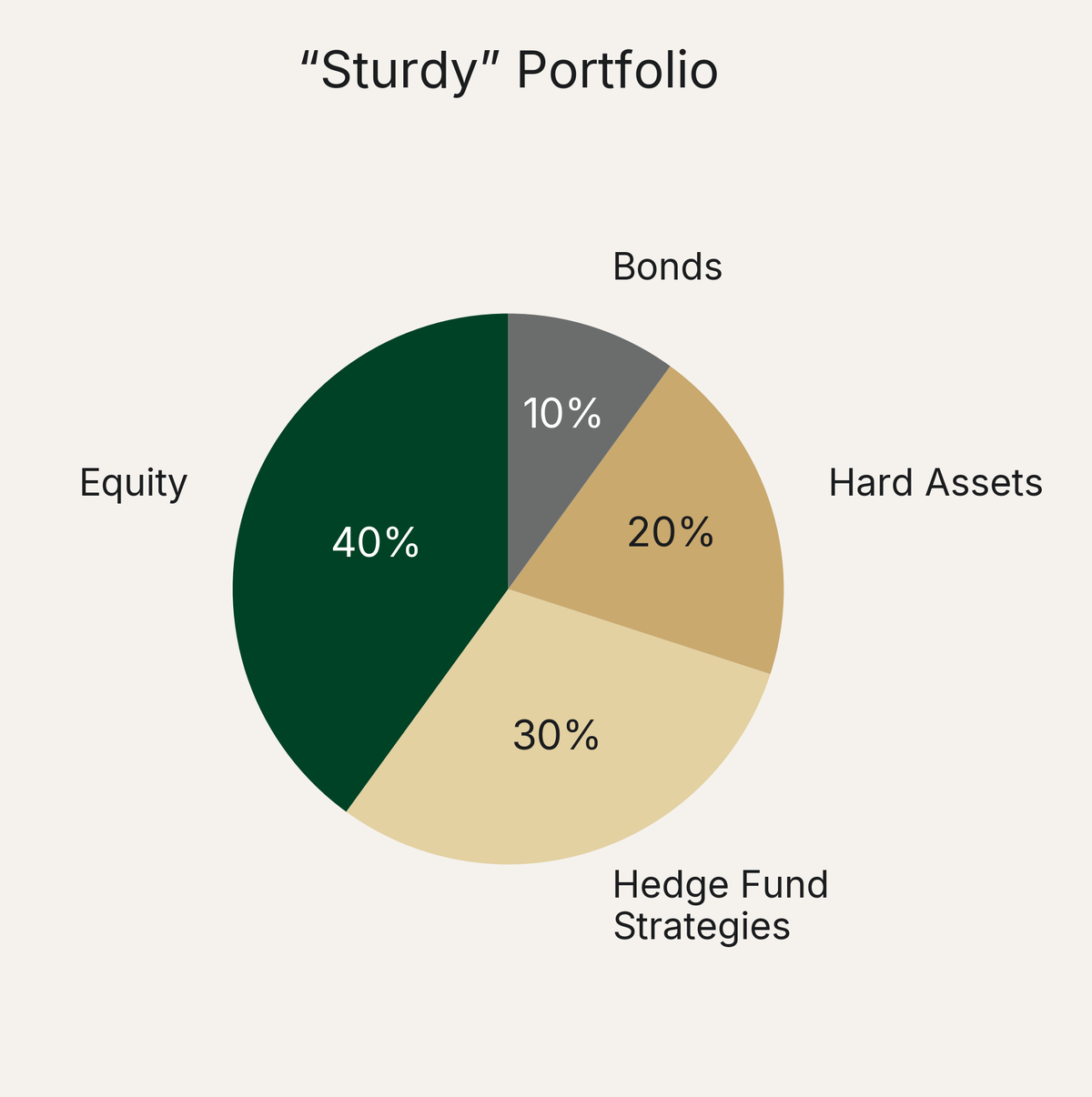
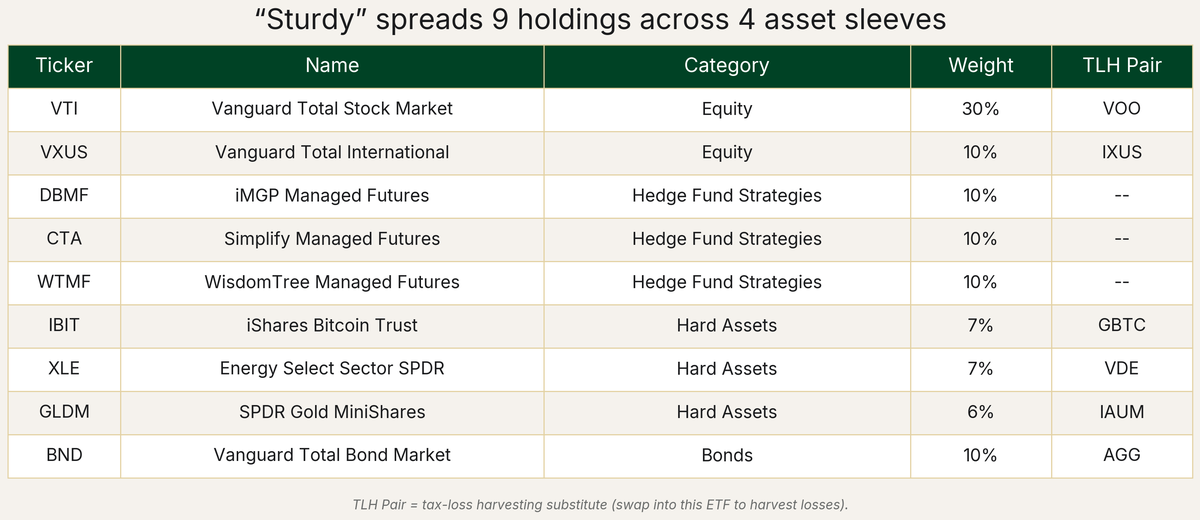
Strategy: 40/30/20/10. 40% equity / 30% hedge fund strategies / 20% hard assets / 10% bonds.
Advantages: Lower volatility for the same long-term performance as Simple. A much smoother ride without giving up return. Diversifies risk exposures away from just stocks.
Disadvantages: Nine holdings means more rebalancing complexity than Simple. Hedge fund ETFs have higher expense ratios (0.65-0.85%) than the equity holdings and take more homework to understand: what they are doing under the hood, how they make money, and when they pay off.
Tax-Advantaged Tweak: Asset location optimization is the practice of placing tax-inefficient holdings in tax-sheltered accounts. Place more BND, GLDM, WTMF, CTA, and DBMF exposure in tax-sheltered accounts and more index fund exposure in taxable brokerage accounts (VTI, VXUS, XLE, IBIT).
What Changed
No changes this month. We looked at replacing WTMF and kept it: it is up 7.0% YTD, second in the hedge fund sleeve behind DBMF, and its 0.66% expense ratio is the lowest of the group.
Tax Loss Harvesting Opportunities
Last month's issue flagged selling IBIT and buying GBTC to capture the bitcoin loss. Investors who made that swap in early June are now past the 31-day wash-sale window and can rotate back into IBIT. GBTC charges 1.50% a year; IBIT charges 0.25%. GBTC did its job as the placeholder, and there is no reason to keep paying six times the fee now that the window has closed. (The model itself still holds IBIT. The model does not simulate taxes, so harvest moves are guidance for taxable accounts, not changes to the model.)
For investors who did not harvest, the list this month:
- IBIT (iShares Bitcoin Trust): started the year at $50.94, now around $35.22, an unrealized loss of about 31%. The substitute is GBTC.
- GLDM (gold): started the year at $85.74, now around $79.17, down about 7.7%. The substitute is IAUM.
- BND (Total Bond Market): down about 1.1% in price since year start. The substitute is AGG. Loss is too small to make this one worth it at this point.
GLDM is the new opportunity here. After this month's pullback, a 7.7% unrealized loss on the gold sleeve is worth harvesting for investors with gains to offset. Sell GLDM, buy IAUM to keep the gold exposure, and wait at least 31 days before rebuying GLDM for the loss to count.
3. "Sturdy+" Portfolio
For: Sophisticated investors comfortable with leveraged ETF mechanics, looking for higher long-term returns than the market and willing to take on volatility.
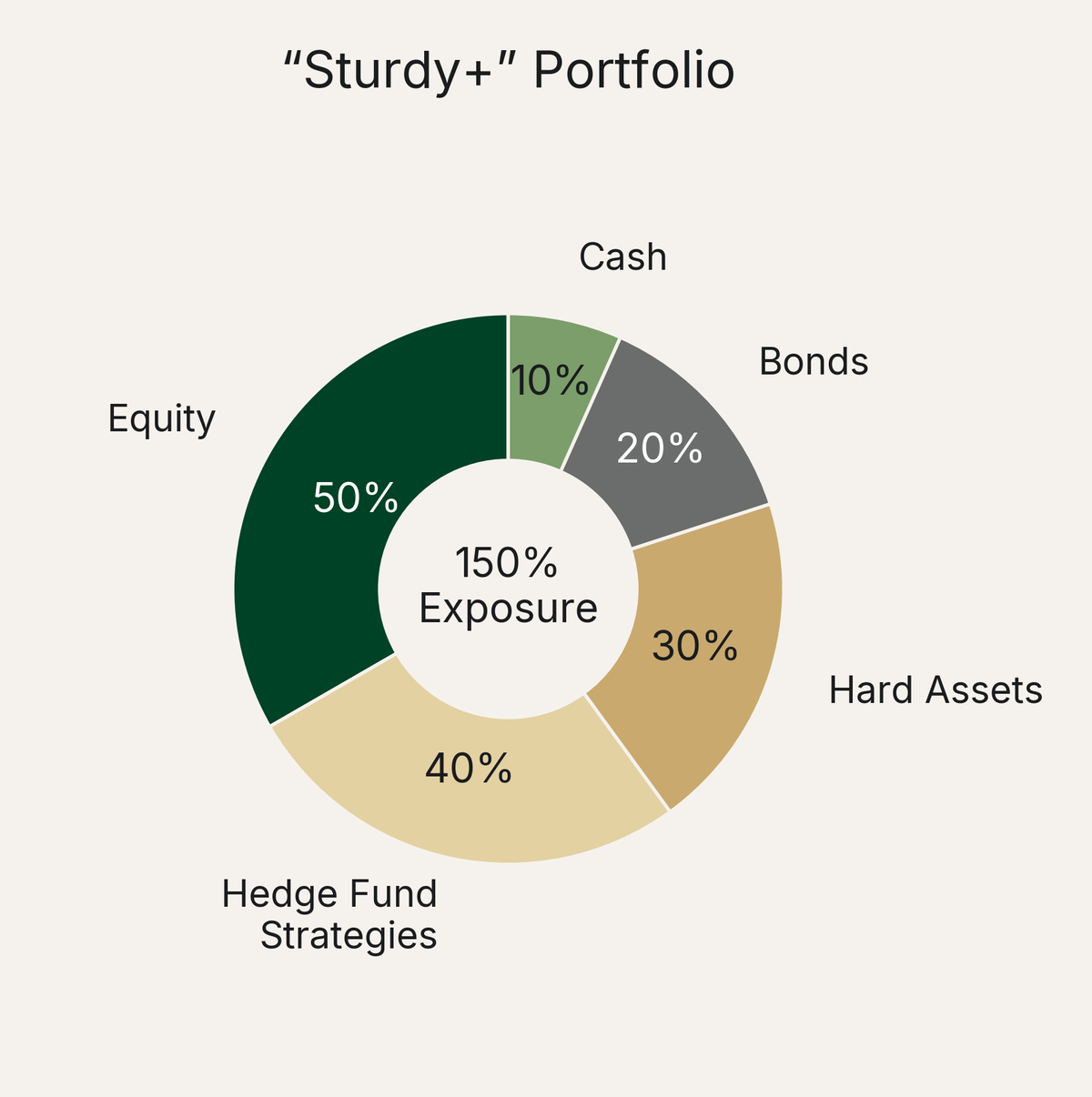
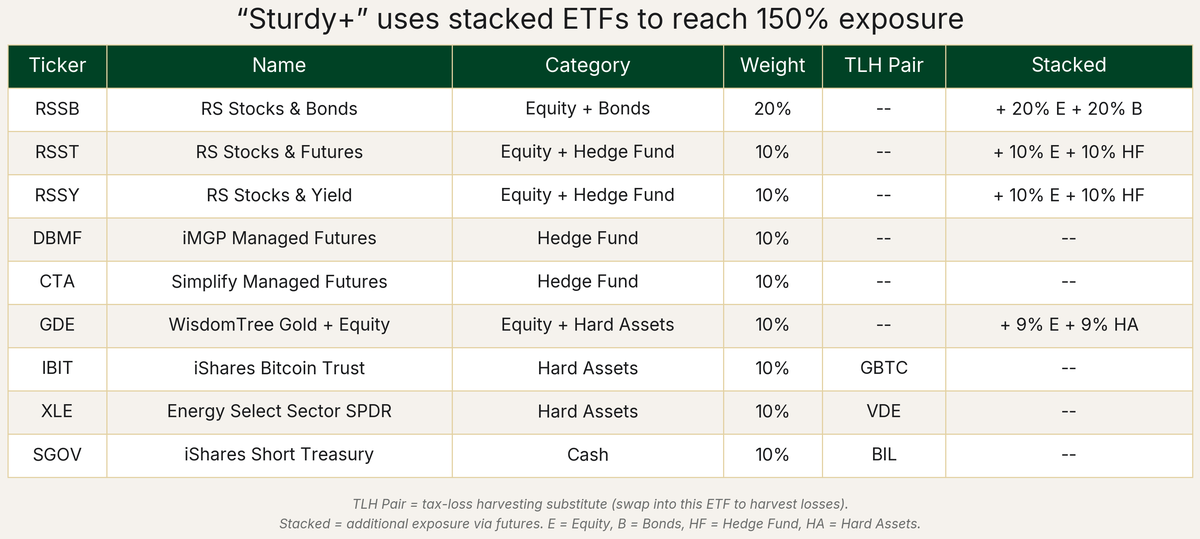
Strategy: 50/40/30/20/10. 150% total exposure via stacked ETFs (RSSB, RSST, RSSY, GDE). A stacked ETF bundles two exposures into one ticker, so $1 invested gives you exposure to both at once.
Advantages: Capital efficiency (getting more market exposure per dollar invested) lets Sturdy+ reach 150% exposure while only deploying 100% of capital. Broker margin (borrowed money from your brokerage used to buy more securities than your cash balance supports) is not needed, so the investor avoids any risk of margin calls and avoids inflated borrowing rates. Investors simply buy these ETFs like any other, and the stacked exposures are already baked in. Futures-based holdings receive 60/40 tax treatment: gains are split 60% long-term and 40% short-term no matter how long you hold them, making this more tax-efficient than you might expect for a leveraged strategy.
Disadvantages: More volatile than Sturdy due to the additional exposure. More complex to understand and requires some effort to learn the mechanics. Stacked ETFs are newer products with shorter track records. Requires comfort with leverage and futures, even though the implementation is straightforward because these ETFs are purchased just like any other ETF.
How the Leverage Works: Four holdings provide stacked exposure:
- RSST (10% of portfolio) = 10% US equity + 10% trend (trend following: a strategy that buys assets going up and sells assets going down)
- RSSY (10% of portfolio) = 10% US equity + 10% carry (carry: earning the yield difference between holding an asset and financing it)
- RSSB (20% of portfolio) = 20% global equity + 20% bonds
- GDE (10% of portfolio) = 9% US equity + 9% gold
Think of stacked ETFs like combination drugs: Augmentin gives you amoxicillin plus clavulanate in one pill. RSST gives you S&P 500 plus a hedge fund strategy overlay in one ticker. Combined with the standalone holdings (DBMF, CTA, IBIT, XLE, SGOV), total exposure reaches approximately 150% while only deploying 100% of capital. Broker margin isn’t required, and a much lower effective borrowing rate than broker margin can be realized.
Tax-Advantaged Tweak: Investors typically prefer holding SGOV in tax-advantaged accounts (Roth, 401(k), 403(b)). Bond interest is taxed at ordinary income and benefits more than the other ETFs from sheltering in tax-advantaged vehicles.
What Changed
No changes this month.
Tax Loss Harvesting Opportunities
The meaningful move is bitcoin if you did not harvest it last month.
- IBIT (iShares Bitcoin Trust): a YTD unrealized loss of about 31%. The substitute is GBTC.
Investors who already swapped into GBTC last month can now rotate back to IBIT: the wash-sale window has closed, and IBIT's 0.25% fee beats GBTC's 1.50%. Investors who have not harvested can still sell IBIT, bank the loss against future capital gains, and buy GBTC to keep the bitcoin exposure intact. GDE and CTA are each down about 1% versus their add prices, which is too shallow to bother with.
Methodology
These model portfolios track a hypothetical investment made on January 2, 2026. All prices use adjusted close from Tiingo (accounts for splits and dividends). No transaction costs, slippage, or taxes are modeled. Benchmarks: SPY (S&P 500 ETF) and AOR (iShares Core Growth Allocation ETF, a 60/40 proxy). All metrics annualized where applicable.
The portfolios are account-agnostic. They work in taxable, traditional IRA, Roth IRA, 401(k), or any other account type. Tax-advantaged tweaks are noted per portfolio as suggestions, not requirements.