The 2-Minute Version
- SpaceX just became the largest IPO in history, and lots of folks are unsure of if they should invest. IPOs create FOMO. How should physicians handle it?
- The data explicitly shows that IPOs have underperformed the market on average a few years out.
- Sometimes the boring answer is best. If you want exposure, just buy a total-market index fund. It will pick up the IPO company quickly, you don't have to worry about when to sell, and the compounding stays tax-deferred.
The Dollar Math Historically, over three years IPOs have trailed the total market by about 20%. For a $50k investment, that's an additional $10k over 3 years that required less work and headache.
Last Friday, June 12, SpaceX became the largest IPO in history. The stock popped about 19% on its first day. The company also cleared a $2 trillion valuation making it immediately one of the largest publicly traded companies. Many physicians have asked themselves: "Am I missing out?"
Our general answer to that question is to keep your head down and continually invest in long-term ETF (exchange-traded fund) holdings. The flashy 19% on Day 1 number belonged only to those who had an allocation at the $135 offer price, which was almost entirely institutions. Individual investors rarely get allocations to headline IPOs at the same price that the large financial institutions do. By the time most physicians could have made an open market purchase of SpaceX, the stock was at $150 and their Day 1 return was limited to single digits. Anyone who bought after the first-hour spike near $175 was down by the close. This illustrates the trickiness of IPO pricing. For most physicians it is better to wait until the companies are added to index funds and gain their exposure through that avenue rather than buying the stock outright. The chart below shows returns on the IPO day of SpaceX based on what price you were able to access.
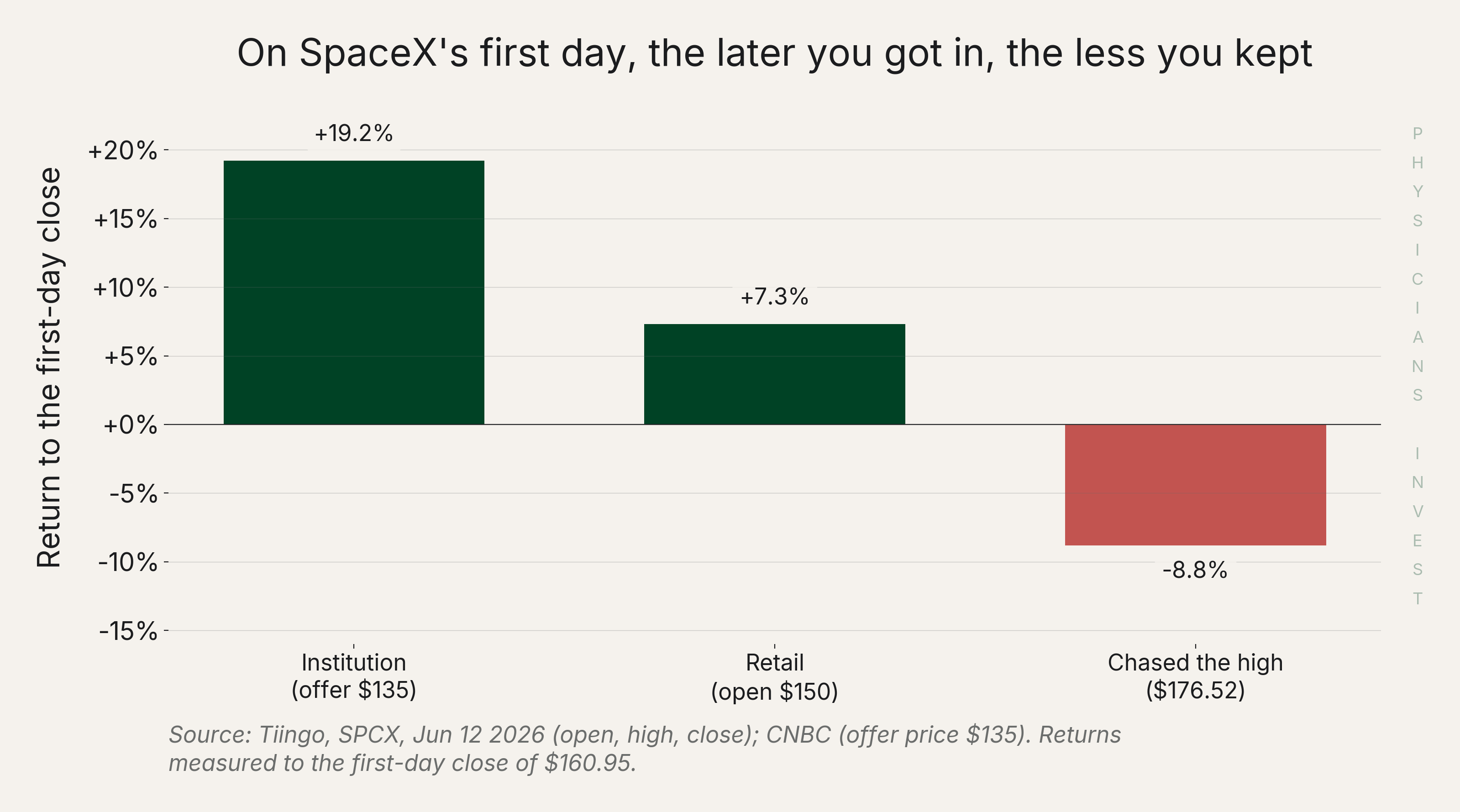 Source: Tiingo (SPCX), CNBC. Returns to the first-day close of $160.95.
Below is our analysis of IPOs and our take on how physicians should approach them.
First, understand who gets the headline price as their entry point
An IPO has a pecking order, and unfortunately physicians sit near the bottom. IPOs have an offer price, which underwriters allocate to favored institutions rather than individual investors - this is the $135 you saw for SpaceX. For most IPOs, roughly 75% or more of the shares in hot deals go to institutions and they agree to that price before the stock ever trades on an exchange. Everyone else can buy in the open market once the stock begins trading. The frustrating part is that the stock often makes most of its gains in the seconds after it opens meaning that most individuals are buying at a significantly marked up price from the offer. This table outlines the pecking order:
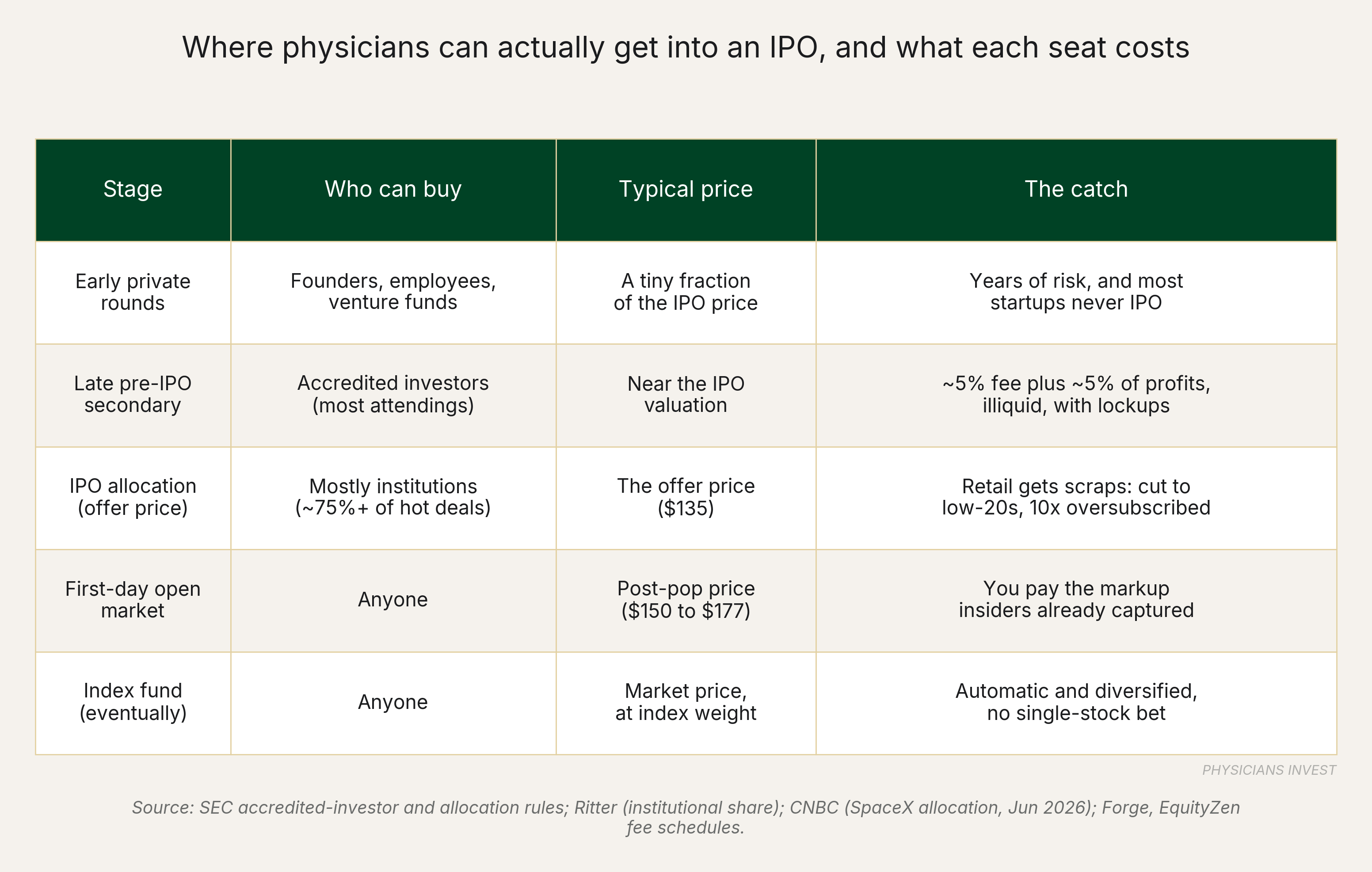 Source: SEC, Ritter, CNBC, Forge/EquityZen fee schedules.
Even if you got an offer price allocation from your broker, IPO investments tend to lose to the broader market over time
Say you landed an IPO allocation through your broker because of a good relationship. It still might not be wise to invest as studies show that over three years post-IPO, the average IPO has trailed the total market by roughly 20 percentage points. While you see very few disaster scenarios from IPOs where the company falls significantly, investing in the broader market is still a safer bet based on statistics. The bar chart below shows this data from the Ritter IPO study visually.
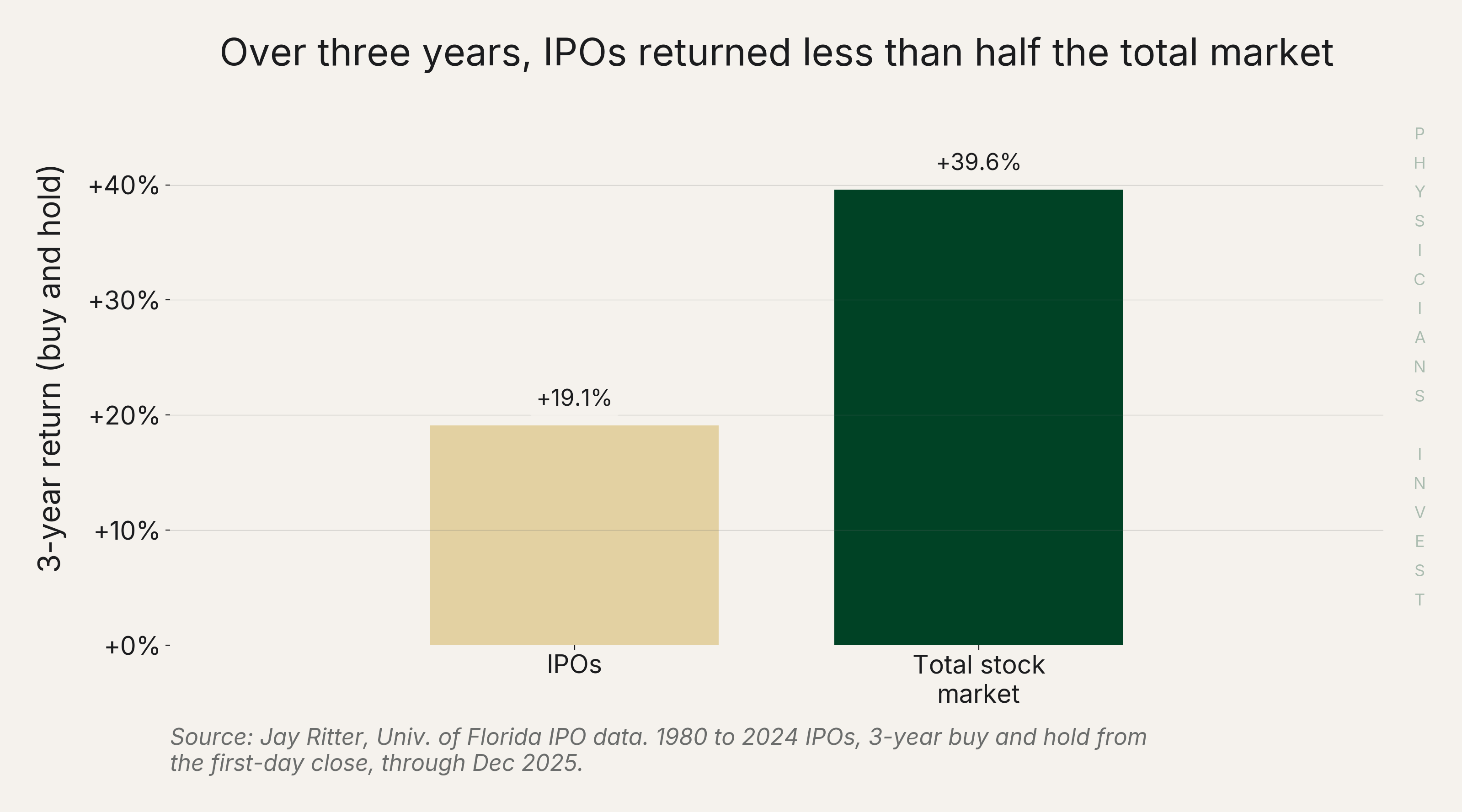 Source: Jay Ritter, University of Florida IPO data.
Why is it that IPOs lag? One of the oddities about public markets is that they are driven by a power law (a small number of stocks produce a disproportionately large share of gains). This inherently makes picking the long-term winner incredibly hard and if you miss out on the winners you underperform the market miserably. Bessembinder at Arizona State University has done some very interesting research on this. He found that over nearly a century, only about 4% of stocks created all of the market's net wealth. Only 4%...let that sink in. Even though the stock market index has consistently performed over the last hundred years, it has been entirely driven by only 4% of stocks. This makes a strong case for indexing because the way the major indexes are structured with weightings by market-cap, it is designed to automatically capture those 4%. If an IPO stock becomes one of those 4%, the index will be holding it. If it happens to not be one of the 4%, you run a massive risk by buying the stock itself and not the market index.
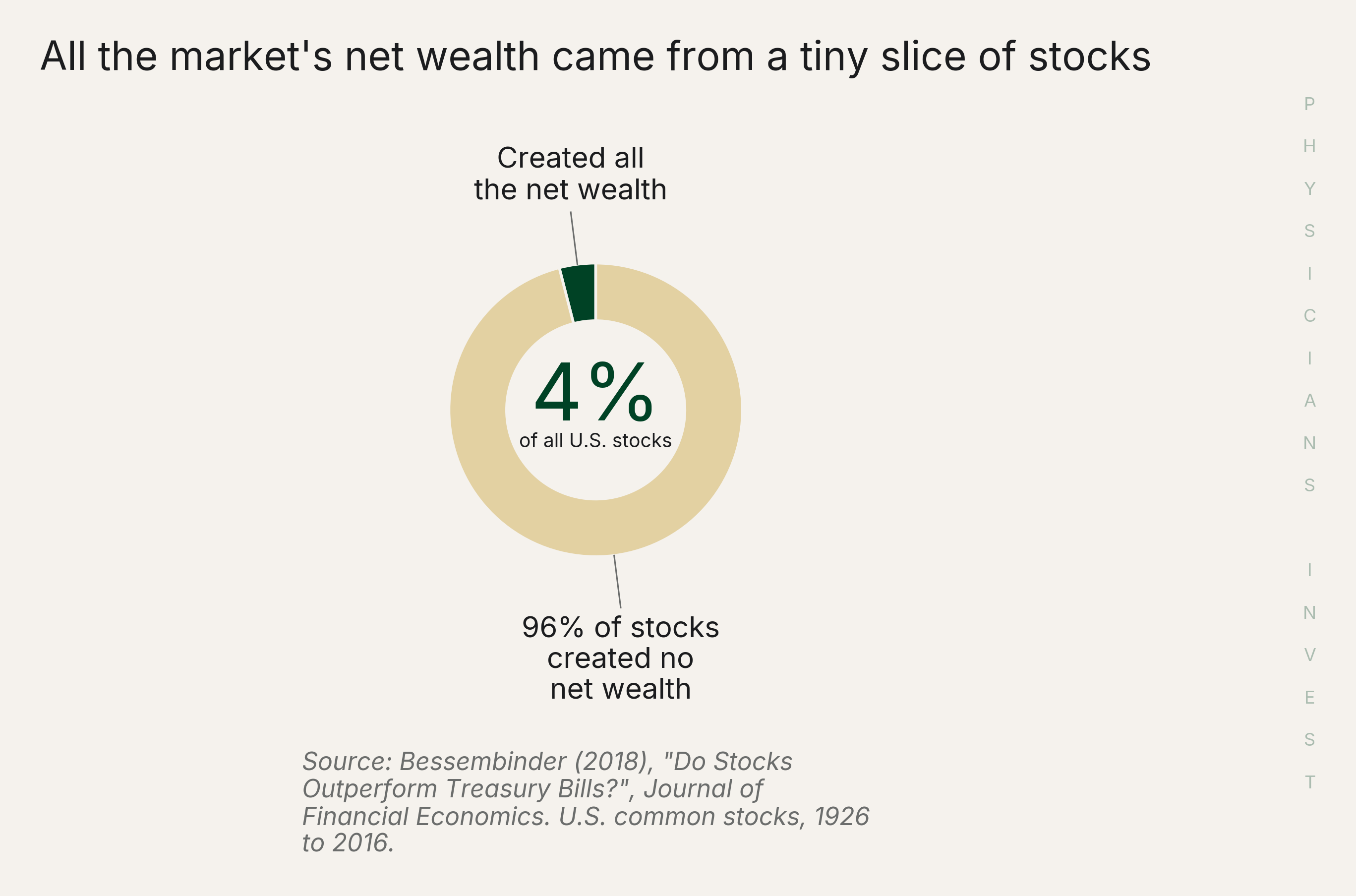 Source: Bessembinder (2018), Journal of Financial Economics.
IPOs will eventually make their way into the indices, albeit at different speeds
All the major US indices have very specific rules about how and when companies are added to the index. A total-market index fund like VTI can hold a brand-new IPO within about five trading days, whereas the S&P 500 makes the stock wait a full year -- a rule S&P reaffirmed as recently as June 4, 2026. These are both considered "index funds," but they treat IPO companies very differently. The plot and table below show days to index inclusion after a stock becomes public for various common index ETFs.
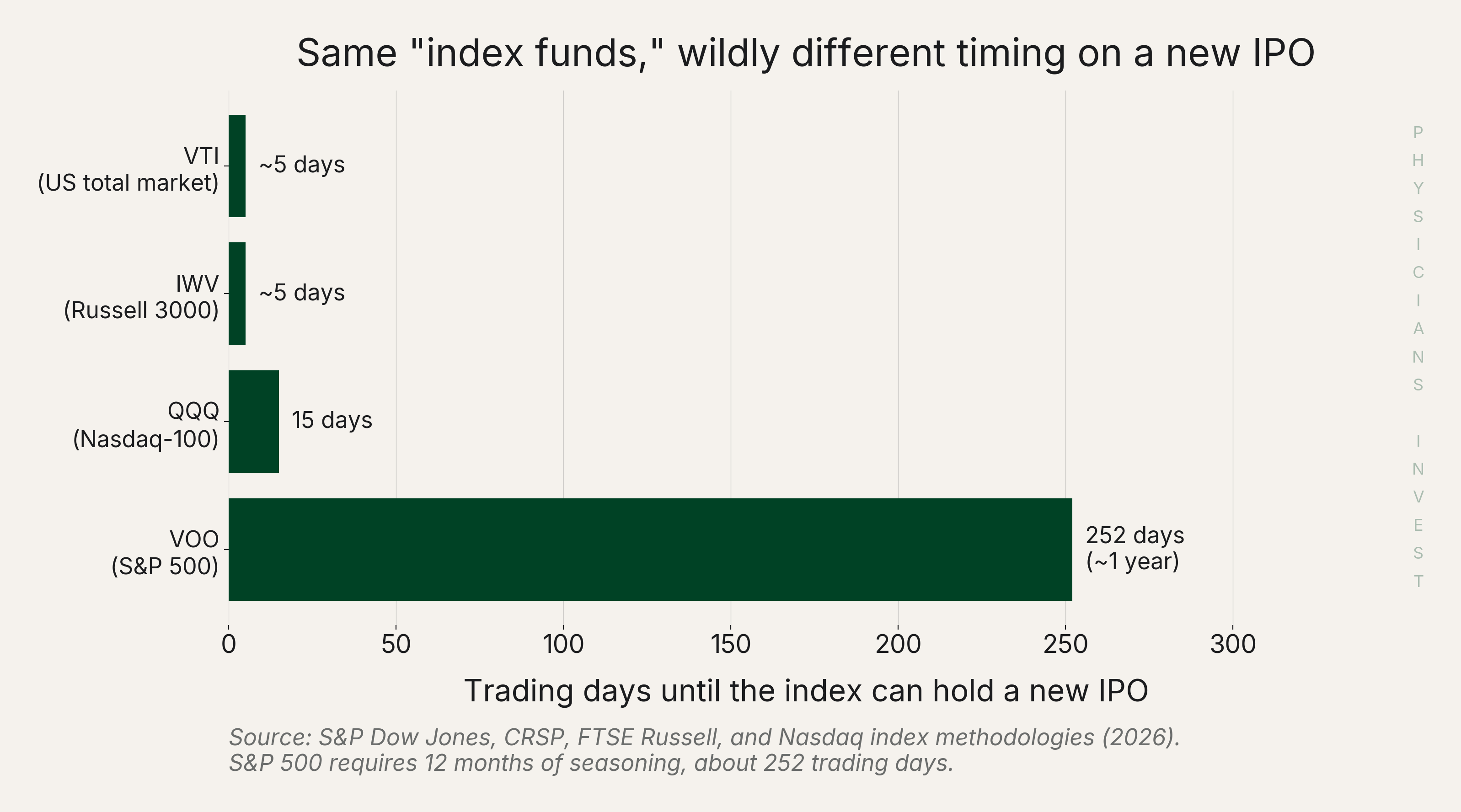 Source: S&P Dow Jones, CRSP, FTSE Russell, Nasdaq index methodologies.
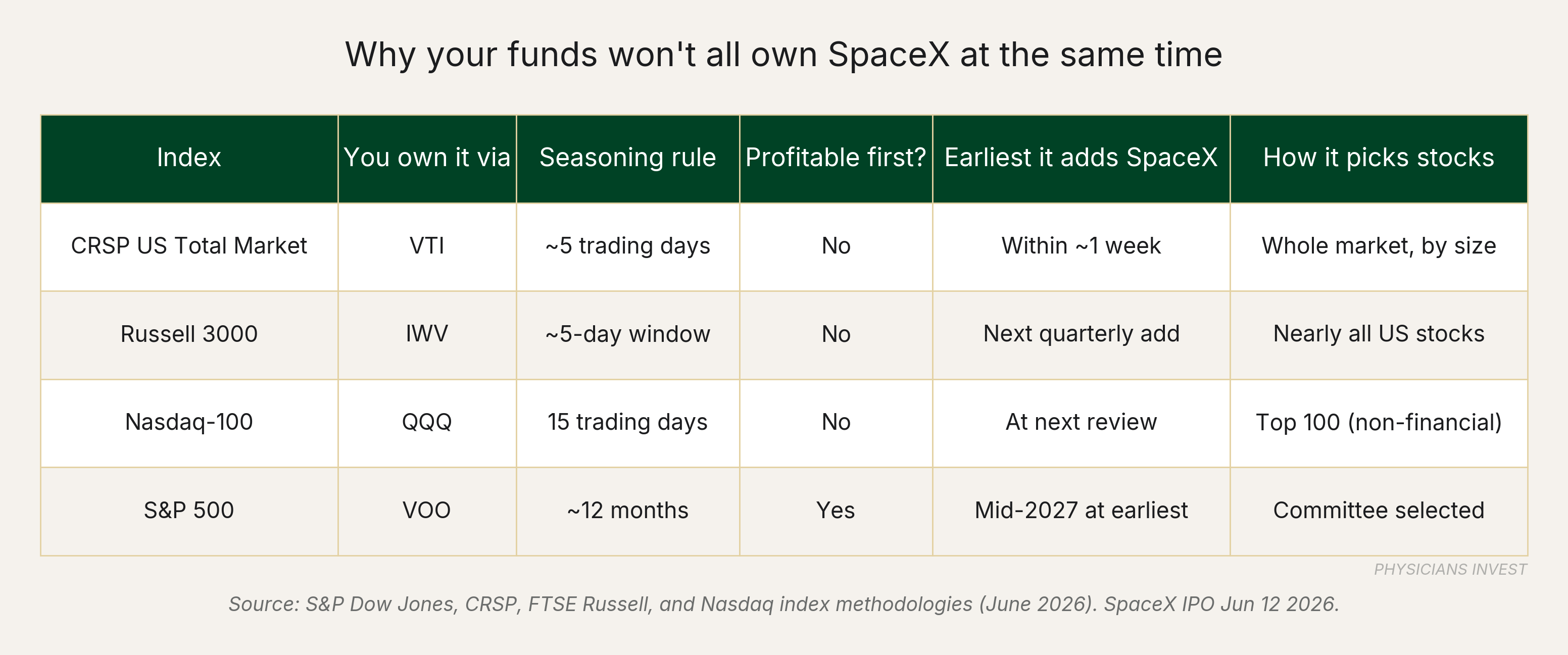 Source: index methodologies, June 2026.
Knowing all this, what do I do?
The Move
- Want the exposure to large IPOs immediately? We think owning a total-market index fund like VTI beats buying the stock. It absorbs companies this large almost immediately, your growth is tax-deferred, you don't have to make hard decisions on when to sell, and the IPOs that end up being long-term winners will continually be weighted higher and higher in the index as they grow. Note: S&P 500 ETFs (VOO/SPY) will not hold these stocks until a year later at a minimum.
- Selling appreciated holdings to chase a name rarely works in your favor. That triggers a capital-gains tax bill and interrupts the tax-deferred compounding. Breaking that just to get access to SpaceX can result in much poorer after-tax returns than if you had just held and waited for the ETF to include SpaceX.
- If the index ETF play feels too boring and you have to own the stock, treat it like an unproven therapy. Tiny dose (a common rule of thumb is 1% of your portfolio or less), expect serious drawdowns (peak-to-trough price drops you ride through), and hold it with a 10-plus year mindset as an asymmetric upside bet. Understand this is truly "risk-capital" and will be a roller-coaster ride up and down.
Sources
Data
- Initial Public Offerings: Long-run Statistics (Jay Ritter, University of Florida) -- 3-year and 5-year post-IPO return data, 1980-2024
- Initial Public Offerings: Underpricing (Jay Ritter, University of Florida) -- average first-day return 19.0%, 1980-2025
- Do Stocks Outperform Treasury Bills? (Bessembinder, Journal of Financial Economics, 2018) -- 4% of stocks created all net market wealth, 1926-2016
- SpaceX IPO: market cap tops $2 trillion (CNBC, 2026-06-12) -- first-day close price, $2T valuation
- SpaceX cuts retail IPO allocation to low 20% range (CNBC, 2026-06-11) -- retail allocation cut from ~30% to low-20s range
- SpaceX targets $135 IPO price (CNBC, 2026-06-03) -- offer price and deal terms
Analysis
- Institutional Allocation in IPOs (Aggarwal, Prabhala & Puri, Journal of Finance, 2002) -- institutions receive ~75% of shares in hot IPO deals
- CRSP US Total Market Index Methodology Guide -- VTI ~5 trading day fast-track for large IPOs
- SpaceX overvalued by half, smart investors will wait (Fortune/Morningstar, 2026-06-03)
- IPO Data hub (Jay Ritter, University of Florida) -- full academic dataset on IPO performance
Policy
- SpaceX blocked from early S&P 500 entry as S&P reaffirms seasoning rules (CNBC, 2026-06-05) -- S&P 500 12-month seasoning rule reaffirmed June 4, 2026
- Accredited Investors (SEC) -- income and net worth thresholds for accredited investor status
- Pre-IPO Investment Scams, Investor Alert (SEC) -- SEC warnings on unregistered pre-IPO offerings
Related from Physicians Invest
- The Q1 Report Card: Why Your Portfolio Felt Worse Than It Should Have
- The Siren Song of Private Credit in Your 401(k)
- Should Physicians Own Oil & Gas?
Off the Clock
A Chart We Love: This one made the rounds on X the same week SpaceX listed. It shows a handful of today's giants and what their shares cost at IPO, split-adjusted. NVIDIA at $0.04/share. Amazon at $0.075/share. The wrinkle we'd add: these are the survivors, and for every NVIDIA there's a pile of names nobody remembers that seemed promising at the time of their IPO. Hold the index long enough and you end up owning the winners without ever having to guess which is which.
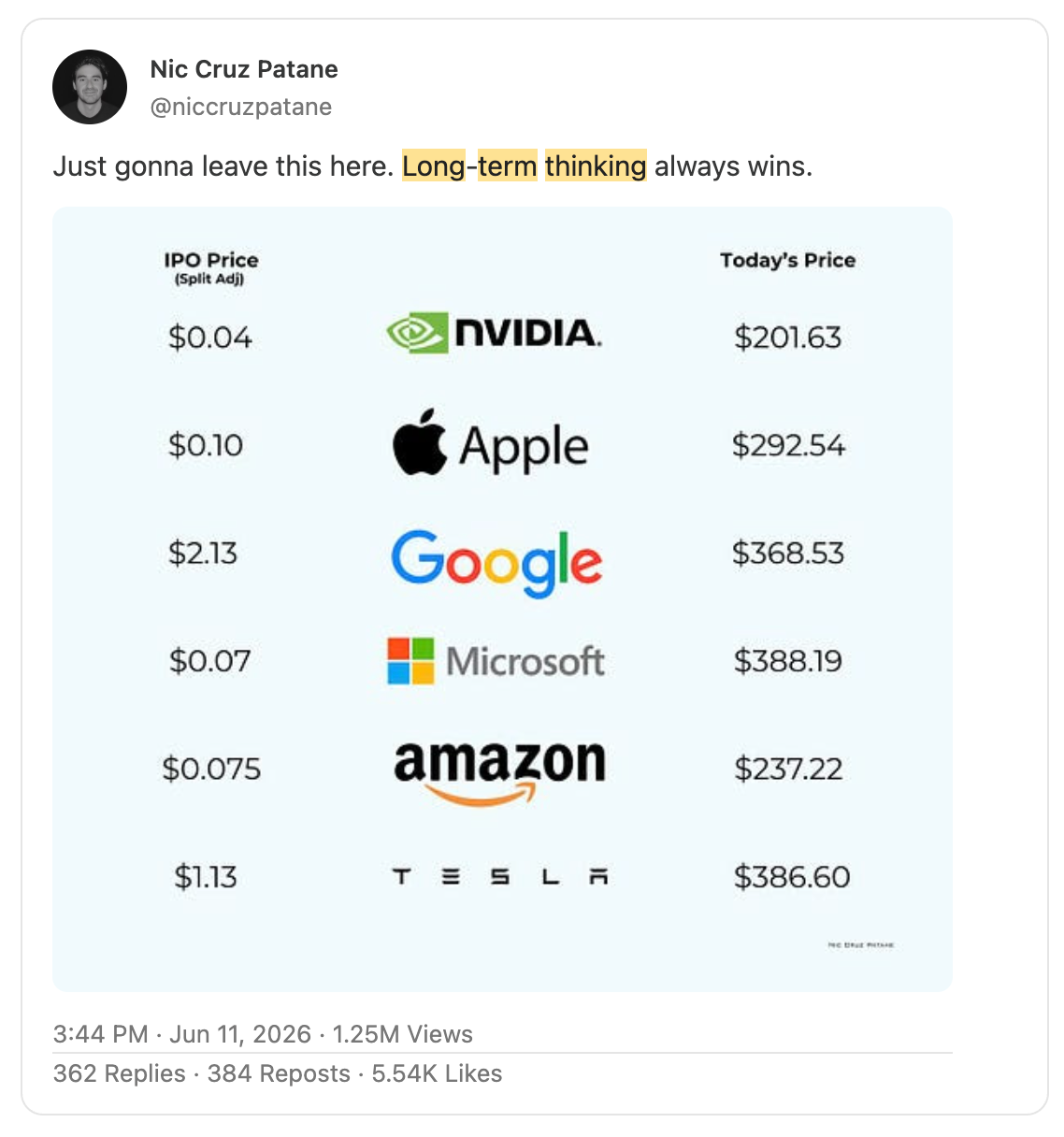 Via @niccruzpatane on X (June 11, 2026).
Seen a stat that stuck with you this week? Hit reply.