The 2-Minute Version
- The average physician incentive bonus is $51,000 which is far lower than other high income professions. This creates a behavioral issue where other professions structurally save and invest more than physicians even though total compensation is similar. This is because of the lump sum effect.
- The behavioral problem: Research shows steady, frequent income makes people feel richer and spend more, while lump sums get booked as assets and invested. In other words, lifestyle creeps up to your bi-weekly paycheck income. Bi-weekly income is often mostly spent, lump sum payments are often mostly invested.
- The fix: auto-sweep 10-20% of paycheck into a brokerage you never look at, and invest the whole balance on two self-declared bonus days a year.
The Dollar Math A 10% self-paid bonus on a $300K salary sets aside $30K a year systematically. At a hypothetical 7% growth rate that's about $415K after 10 years and $1.2M after 20.
Physicians hold most of the top spots on the list of America's highest-paid professions. So why do other professions seem to build wealth more effectively?
Every January, your college roommate who is now at Goldman gets a deposit of more than 50% of their annual salary. Your Big Law friend banks a six-figure bonus regularly. Your engineering buddy watches a large block of company stock vest every fall. And you, out-earning most of them on total compensation, get no lump sum bonus but rather, the same direct deposit every other Friday. This creates a behavioral trap for physicians.
We have a strong point of view that this “physician bonus problem” is why physicians struggle to keep up with peers in other high-income professions on total net wealth. Lifestyle creep typically creeps up to the paycheck amount. Lump sum bonuses are not part of the normal paycheck so they are typically available to be mostly invested. Physicians have to work extra hard in order to structurally position themselves to create synthetic lump sum bonuses for themselves. We see this as a crucial financial step for nearly all physicians.
The Setup
In finance, bonuses are roughly 42% of total pay (the average Wall Street bonus hit a record $246,900 last year). Senior Big Law associates are about 24% of comp, in one January deposit. Big Tech runs even higher: a staff engineer's median package is $457K, and with base salaries capping out near $300K, roughly 40% of it arrives as stock and cash bonus. Senior energy engineers run about 25% in cash bonus plus equity, our estimate from industry pay data and typical public-company equity grants.
Physicians? The average bonus is about 13%. And to make matters worse, 33% of physicians get no bonus at all. And to make matters EVEN worse, the bonus is typically paid in the form of a productivity reconciliation, trued up quarterly or annually and folded into your paychecks. So the bonus is still smoothed, and not a lump. See chart below for how various professions stack up.
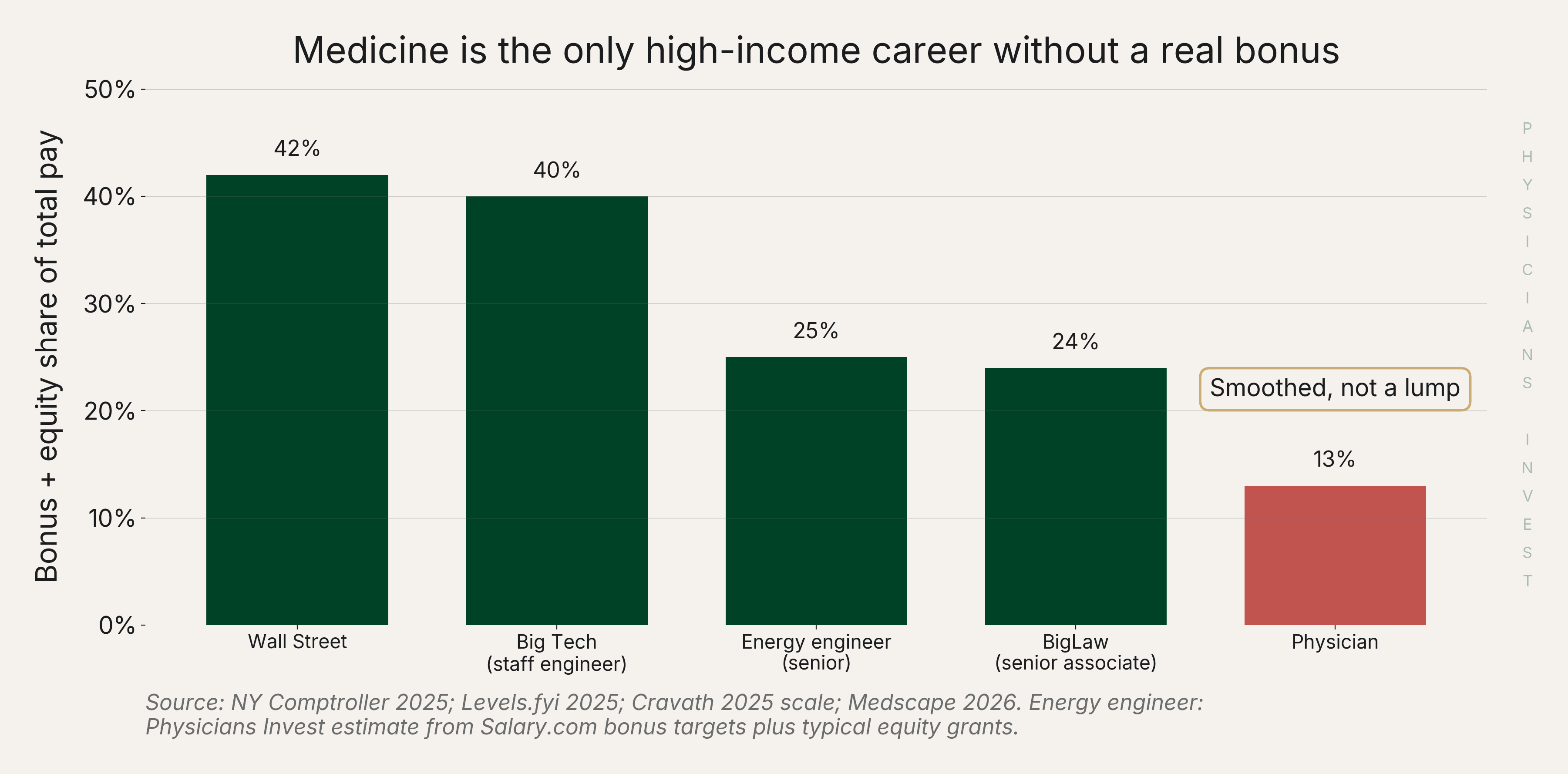 Source: NY Comptroller 2025; Levels.fyi 2025; Cravath 2025 scale; Medscape 2026. Energy engineer: Physicians Invest estimate from Salary.com bonus targets plus typical equity grants.
Physicians also start 7 to 11 years late and typically carry six-figure debt so they miss out on some early compounding. A late start, high debt, and the physician bonus problem all contribute to physicians feeling behind their peers, often for their entire careers. The good news is that you should be able to counteract each of these headwinds with some creative approaches to personal finance. If you follow conventional financial advisor advice, you will forever be behind your peers who are following the same advice but just got an earlier start. To put this in perspective, half of physicians in their late 40s, a decade into attending pay, still haven't crossed $1M net wealth. (That's from the most recent by-age surveys, 2016-2019; physician net worth has drifted up since, but the shape of the curve holds.) This is a statistic that we would like to change.
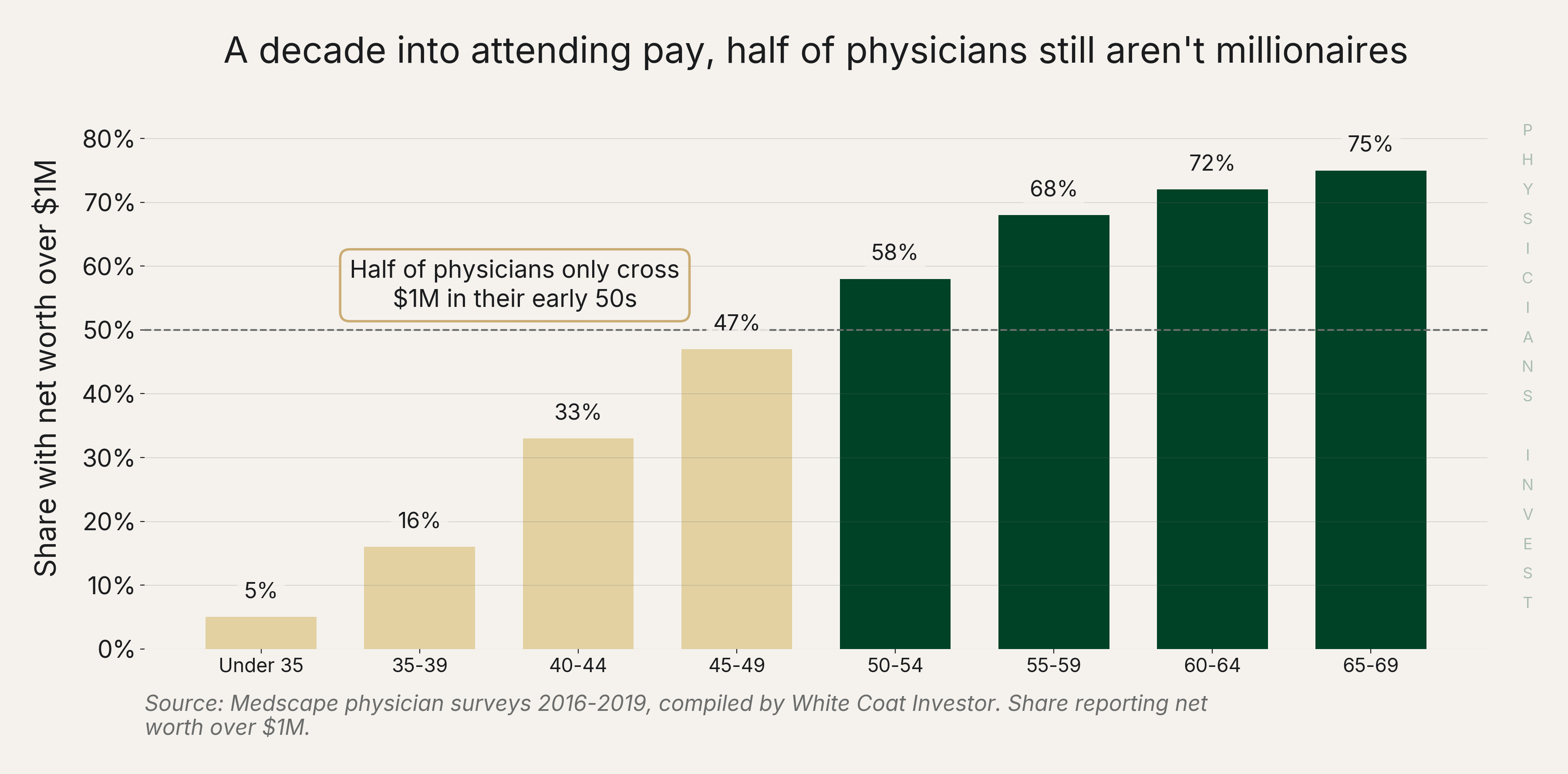 Source: Medscape physician surveys 2016-2019, compiled by White Coat Investor. Share reporting net worth over $1M.
The Analysis
Smooth pay = Lifestyle creep
Payment frequency changes behavior. The Journal of Consumer Research tracked tens of thousands of consumers: the more often people are paid, the more they spend, because steady income removes uncertainty and inflates how wealthy they feel. A physician paycheck every other Friday is a maximum-comfort configuration.
Here's a pattern we often see (does this sound familiar?). The paycheck lands in your checking account, and it sits there until you have time to decide what to do with it. Seeing that number in your checking account feels nice. Life is busy so you don’t move it to your investment accounts immediately. Why rush when it is safe in checking? Also, why not spend a little extra on a dinner this weekend? It’s such a small amount compared to the total amount sitting in checking. Why not spend a little more on the hotel for your upcoming trip to make the stay a little nicer? It’s such a small amount compared to the total amount still sitting in checking. That's lifestyle creep. And no one, I repeat, no one, is immune from it.
Keeping your checking account at a size where you feel poor is the hack.
Meanwhile, lump sum payments behave differently in your head. Mental accounting research shows the bigger the lump, the more of it people treat as an asset to preserve instead of income to spend. And money parked out of sight in a separate account gets spent less than the same dollars sitting in checking.
Bonus pay = Asset building
The good news is physicians can create this structure for themselves with a little bit of elbow grease. Your goal should be to target at least 10%-30% of your salary saved every year, with everything beyond your retirement accounts arriving as a “synthetic bonus.” Here is the math for a $400K/yr total compensation physician sweeping the full 30%. The math is hypothetical, assuming a steady 7% return; actual returns will vary.
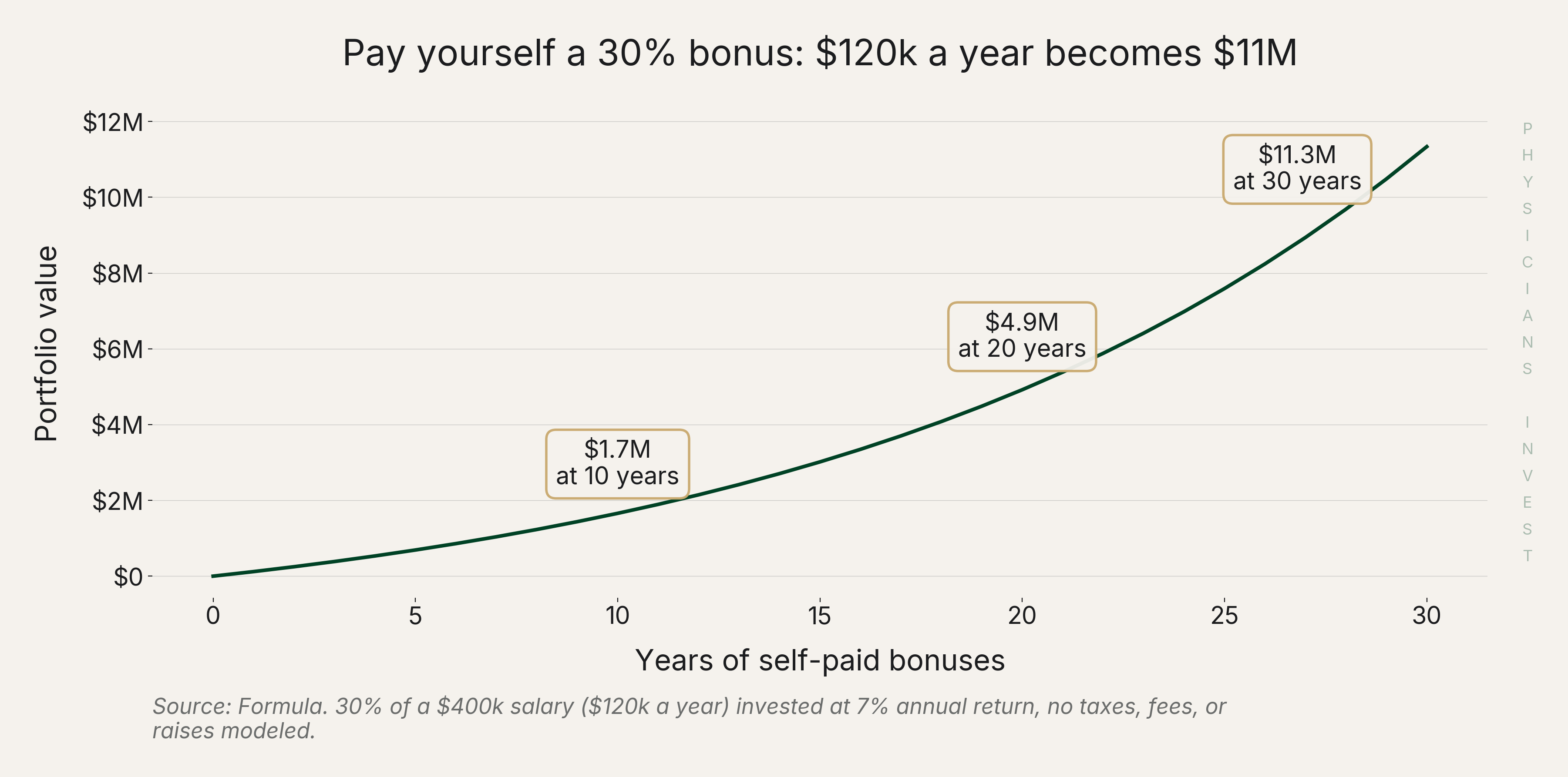 Source: Formula. 30% of a $400k salary ($120k a year) invested at 7% annual return, no taxes, fees, or raises modeled.
A 30% sweep is a stretch for many physician budgets. We think it's achievable for most physicians who build the structure and stick to it. And if you think 30% is too much, that is exactly the point: other professions are saving 30% because the bonus structure requires it. They never had the choice to increase lifestyle because their bonus was never a guarantee. Yet when it comes in it is around 30% of their total compensation. So when they immediately invest that bonus, they are effectively meeting a 30% savings rate even if they are spending 100% of their paychecks.
On the other hand, physicians increase lifestyle expenses to their paycheck and once increased it is VERY hard to reduce. And then no bonus comes in on top of that. So now that 30% seems an impossible savings rate to hit because your lifestyle is already counting on it and now social credibility, comfort, and even personal pride might have to be sacrificed which makes for a difficult psychological decision.
The fix. When your employer doesn’t pay you a bonus. Pay yourself one. And do it before the decision to save becomes too psychologically hard.
The Move
First, keep in mind that the self-paid bonus should be from dollars left AFTER your tax-advantaged accounts are full. We think saving on taxes is much more important than growing your brokerage account. Fill these first:
- 401(k) or 403(b), and maybe the 457(b), if your hospital offers one
- Backdoor Roth IRA (a two-step move that lets high earners fund a Roth even though they're over the direct income limit)
- HSA if you're on a high-deductible plan
- 529s and Trump accounts (the new tax-advantaged kids' accounts) if you have kids
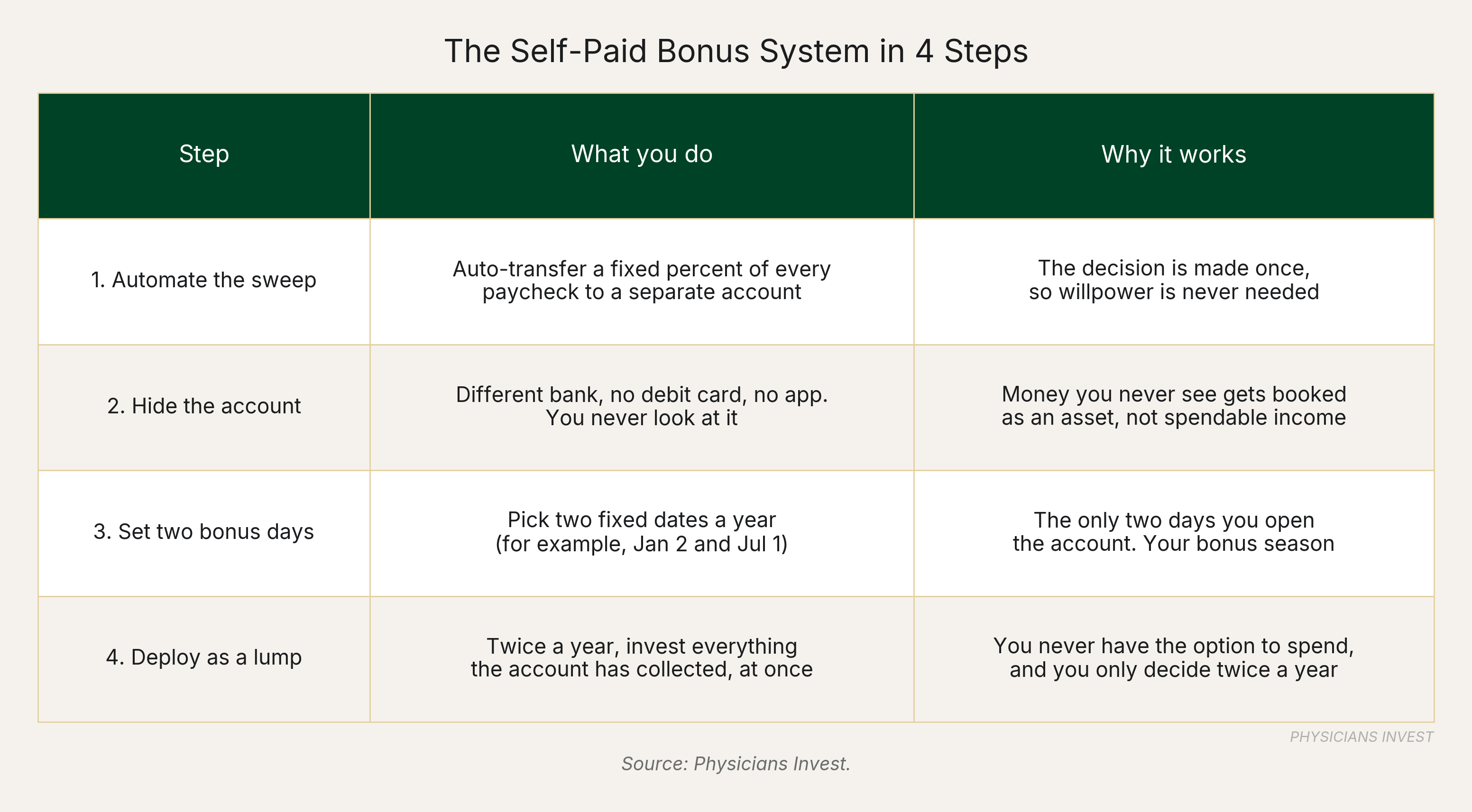
Then build the bonus structure. Four steps:
 Source: Physicians Invest.
- Split your direct deposit at the employer level so a fixed percent lands in a brokerage at a different bank and so that it never touches your checking account.
- Delete the app for that “bonus account.” Try to never look at it.
- Put two bonus days on the calendar (Jan 2 and Jul 1 work fine). Celebrate with something special with your family on those days so that you look forward to reaping the rewards of your discipline.
- On those days, many physicians using this system deploy the full balance into diversified equity exposure at once. Index funds are the most common choice. Some extend into real estate, business ownership, individual stocks, bitcoin, or venture capital, understanding that concentrated and alternative assets carry more risk and less liquidity than a diversified index fund. Your job as a physician building wealth is to convert your high salary into equity ownership over the course of your career.
Here are some hard numbers to shoot for based on salary levels:
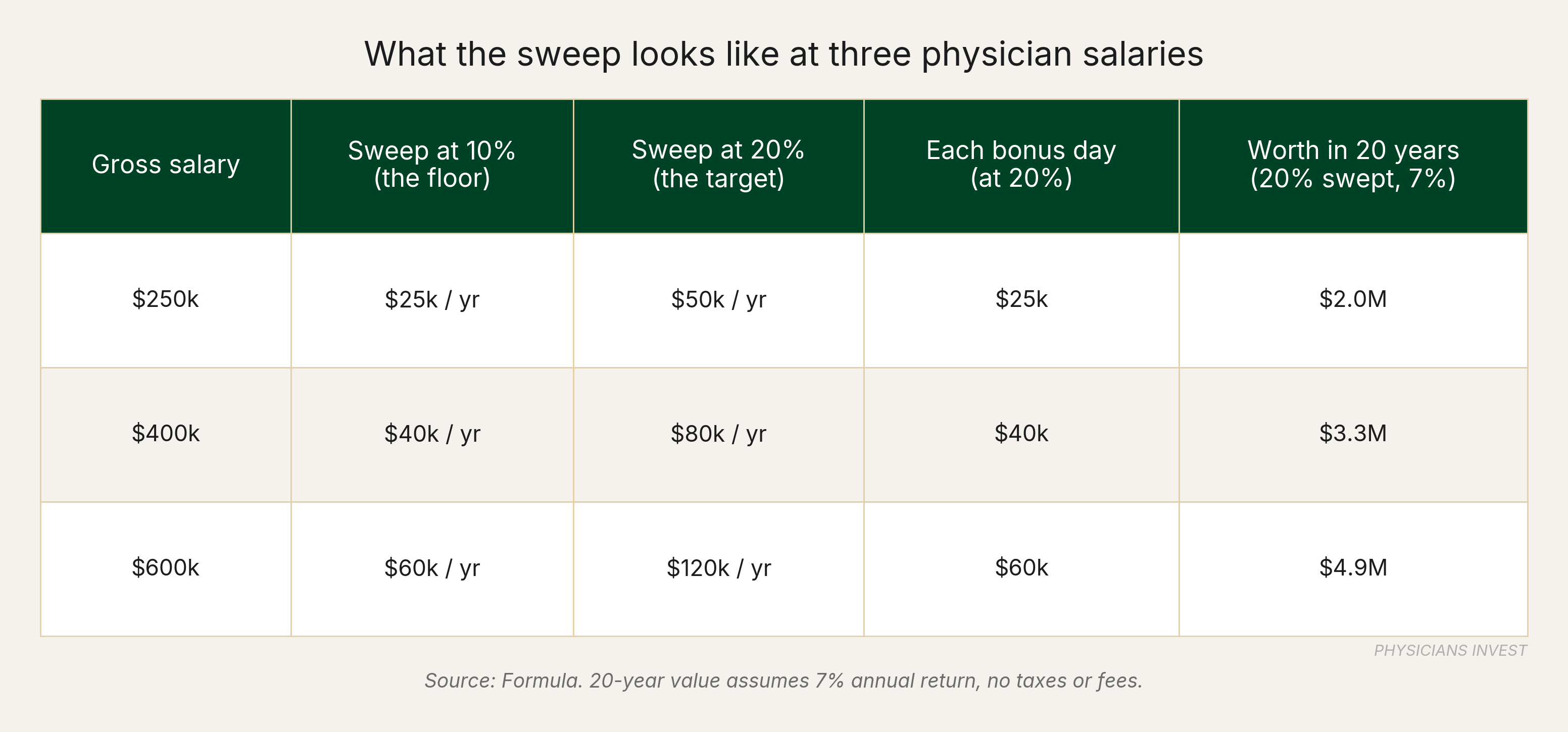 Source: Formula. 20-year value assumes 7% annual return, no taxes or fees.
Aim for 30% of gross across all your saving. Investment is personal so some physicians should save less and take more calculated risk; others need money locked away before they can touch it. It's very, very hard to fight your personality when it comes to finances. Build the best structure that works for you and then stick to it.
Sources
Data
- Medscape Physician Compensation Report 2026 -- average physician comp (
$386K), average incentive bonus ($51K, ~13% of pay), one-third with no bonus - BLS: Highest Paying Occupations (Occupational Outlook Handbook) -- physicians hold most of the top-paid occupation slots (16 of the top 20)
- Levels.fyi End of Year Pay Report 2025 -- staff engineer total comp, equity/bonus share
- Salary.com: Oil & Gas Engineer Compensation -- energy engineer cash bonus targets; the 25% figure is a Physicians Invest estimate including typical public-company equity grants
- White Coat Investor: Physician Millionaires by Age -- share of physicians who are millionaires, by age cohort (Medscape data)
- BLS OOH: Physicians and Surgeons -- training length (4 years medical school + 3-9 years residency + 1-3 years fellowship)
- AAMC: Physician Education Debt and the Cost to Attend Medical School -- median medical school debt $200K, Class of 2025
Policy
- NY State Comptroller: $246,900 average Wall Street bonus, up 6% in 2025 -- Wall Street average bonus and bonus share of industry wages
Analysis
- ABA Journal: Cravath kicks off associate bonus season -- BigLaw senior associate bonus share of comp
- De La Rosa & Tully, "Psychological Effects of Income..." Journal of Consumer Research 48(6) -- payment frequency and spending behavior
- Bernard: Mental Accounting and the Marginal Propensity to Consume (SSRN) -- lumps booked as assets, streams booked as spendable income
Related from Physicians Invest