The 2-Minute Version
- Being a 1099 physician opens significant tax advantages compared to W-2.
- The biggest lever is a solo 401(k) with the mega backdoor Roth along with extensive deduction opportunities.
- While 1099 opens up tax benefits, the tradeoff is that it comes with increased complexity and record-keeping requirements.
The Dollar Math A 1099 physician who opens a solo 401(k) and contributes the full $72,000 keeps roughly $25,000 out of the IRS's hands this year assuming a 35% bracket. That money also keeps growing sheltered from tax every year after.
Being self-employed comes with tax advantages not available to W-2 high earners. All self-employed physicians should take advantage of these opportunities and W-2 employed physicians should consider starting something on the side that qualifies as a business in order to have exposure to the gold-mine of tax benefits available to 1099 earners.
The main benefits of 1099 are that it allows you to offset much of your income through business expenses and deductions and it opens unique retirement savings vehicles such as the solo 401(k) and cash-balance plans.
These advantages come with tradeoffs, notably administrative overhead, Self Employment Tax, and IRS quarterly estimates. We view the costs well worth the reward and advise most physicians to figure out a way to have some sort of 1099 income.
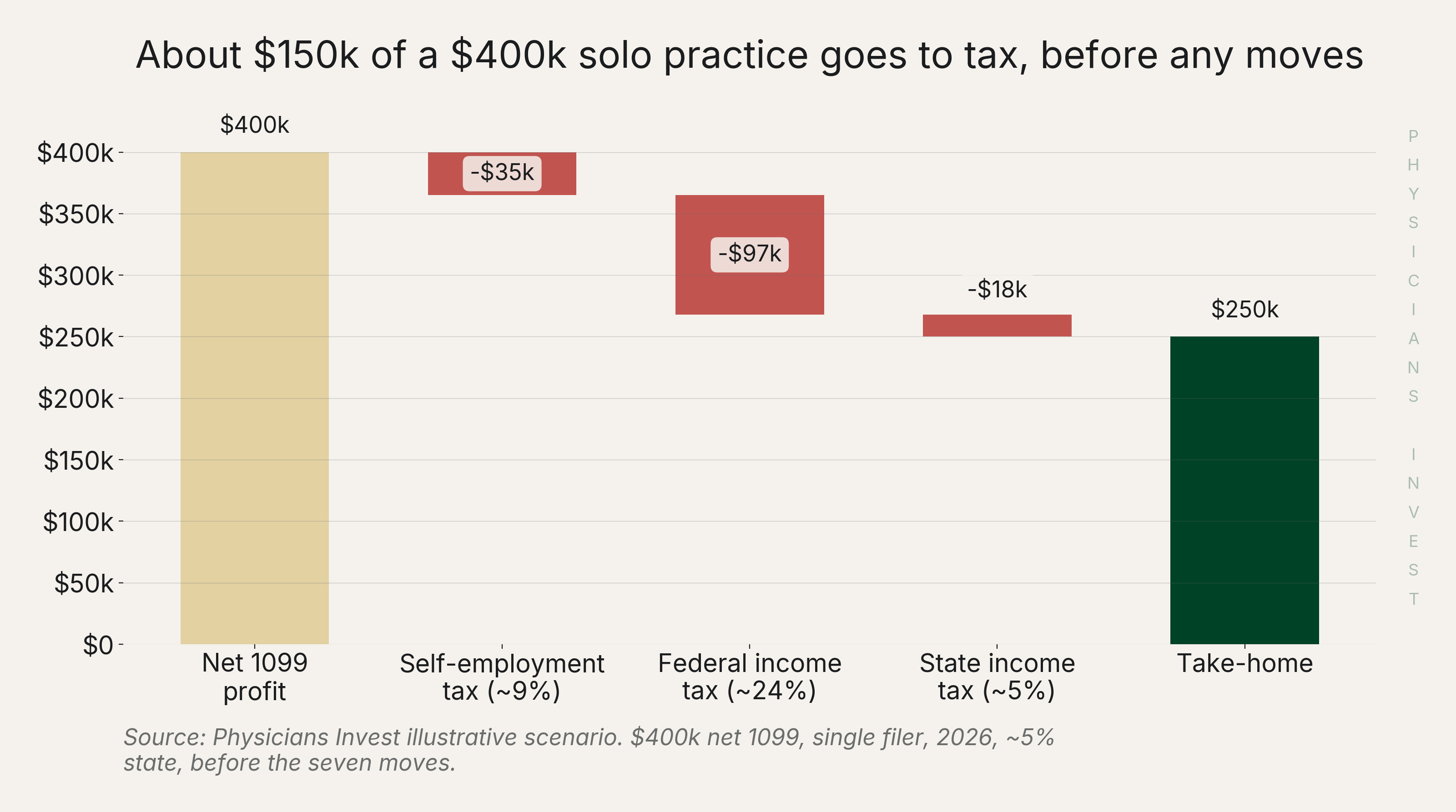 Source: Physicians Invest illustrative scenario. $400k net 1099, single filer, 2026, before the seven moves.
Here are the seven moves that matter most, in the order we would run them.
- Set up a solo 401(k), and use the mega backdoor Roth (extra after-tax 401(k) contributions converted to Roth, on top of the normal deferral limit). This is the biggest lever for long-term tax savings by a wide margin. A solo 401(k) shelters up to $72,000 in 2026 ($80,000 to $83,250 once you hit the catch-up ages). Further, a plan that allows after-tax contributions plus in-plan Roth conversions (moving those after-tax dollars into the Roth bucket inside the same plan) lets you push far more into Roth than the standard $24,500 for a 403(b) or 401(k) that an employer would offer. That is a huge amount of Roth money every year that you can place behind a tax shield that grows tax-free forever. We have set one up ourselves on the Roth side. The catch is that most off-the-shelf brokerage plans block the after-tax feature. You need a plan document that allows it and this comes with extra paperwork and filings each year. This is aptly named the mega backdoor Roth due to the very large sums that can be sheltered, and for more details on it please see our Backdoor Roth guide. Another retirement account open to 1099 physicians is the SEP-IRA (a simplified small-business retirement plan funded solely by employer, i.e. self-employed, contributions). Our advice weighing the pros and cons is to skip it and just focus on the solo 401(k) allocation, since a SEP-IRA balance can negatively affect a backdoor Roth by pulling into the pro-rata calculation.
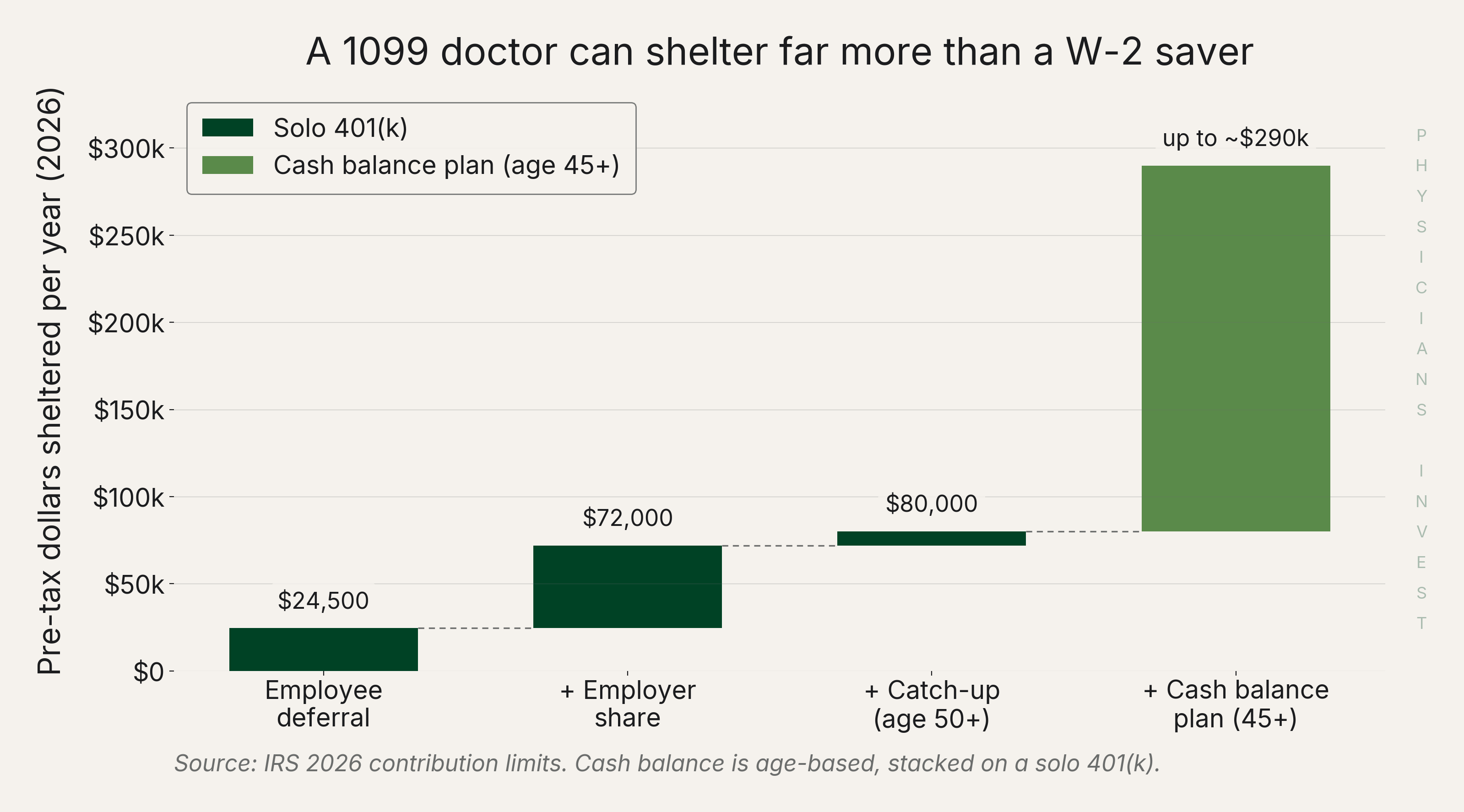 Source: IRS 2026 contribution limits. Cash balance is age-based, stacked on a solo 401(k).
-
Max out an HSA. The health savings account is the only triple-tax-advantaged account you have: deductible going in, tax-free growth, and tax-free coming out for medical costs. In 2026 the limits are $4,400 for individual coverage and $8,750 for a family. How do you get access when you don't have a company sponsored HSA? Self-employed physicians need to buy an HSA-eligible high-deductible plan on the ACA marketplace (healthcare.gov) or straight from an insurer, then open the HSA itself at a provider through that plan. This can create some more administrative overhead and can be complex on first attempt but many companies and services are focused on making this as easy as possible.
-
Nail your quarterly estimates. No employer is withholding tax from your pay when self-employed, which means the IRS wants four estimated payments a year. The sticker shock from the quarterly estimate bills can be tough to swallow the first time but it's a cost of all the other benefits earned through the self-employment track. A good rule of thumb is to pay a quarter of the "safe-harbor amount" (110% of last year's total tax if you are a high earner) on time each quarter and you are good to go.
-
Deduct everything the code lets you. This is the meat and potatoes section of the tax benefits. As a 1099 physician, ordinary business costs come straight off your income, and with the proper records can offset much of what you are already paying in expenses anyway. The self-employed health-insurance deduction alone writes off 100% of your premiums. A home office used regularly and only for work is deductible, up to $1,500 on the simple method. Mileage between sites and travel to locum assignments count (commuting doesn't by the way). Physician specific expenses also count such as: continuing education (CME), state licenses, your DEA registration, board and maintenance fees, malpractice premiums, equipment, and society dues. The table below is a checklist of the most common deductions. Please make sure you follow IRS rules on record-keeping for each of these.
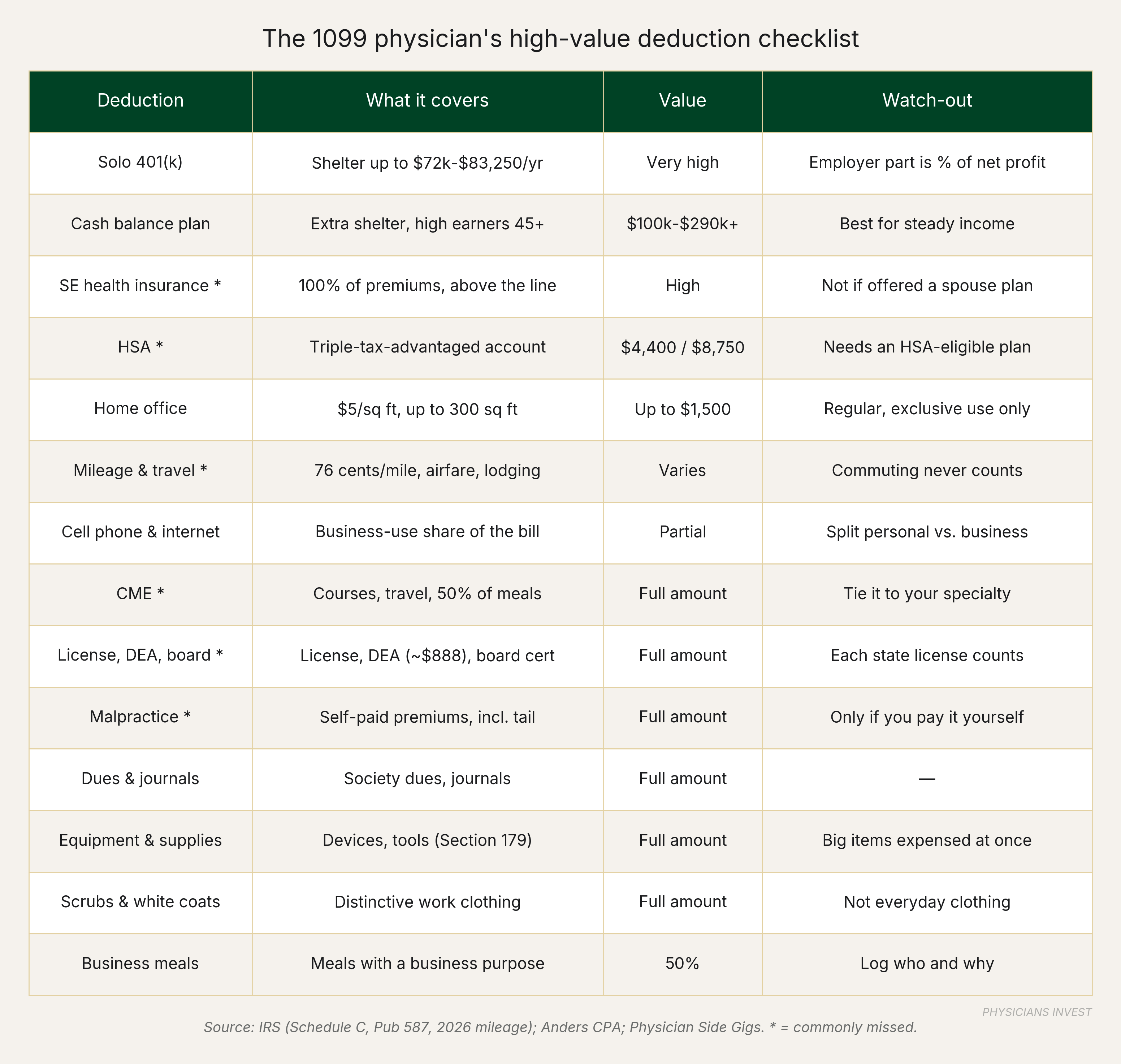 Source: IRS (Schedule C, Pub 587, 2026 mileage); Anders CPA; Physician Side Gigs. Star marks the ones doctors most often miss.
One deduction you probably can't use: QBI. You may have heard about the 20% pass-through deduction. Medicine is a "specified service business" ("SSTB" for short), so above roughly $553,500 of joint income the deduction is fully phased out. Don't plan on being able to utilize QBI as a high earner.
- Weigh an S-corp, and get your reasonable salary right. Once your net income is high and steady, electing S-corp status can trim the Medicare slice of your tax by splitting your income into a salary and distributions. The catch is the "reasonable salary" the IRS requires you to pay yourself first. Do NOT make this $0 or a token number, which is one of the fastest ways to raise your audit risk and get those distributions reclassified as wages. Do the research on your specialty's market range, and if you can find something in the bottom quartile, that is a very defensible answer. Courts have upheld salaries in that range when they are backed by market data and documented. You do not have to pay yourself the top private-practice wage. Document how you got to the number. We built a chart of common specialties to help with this. See below.
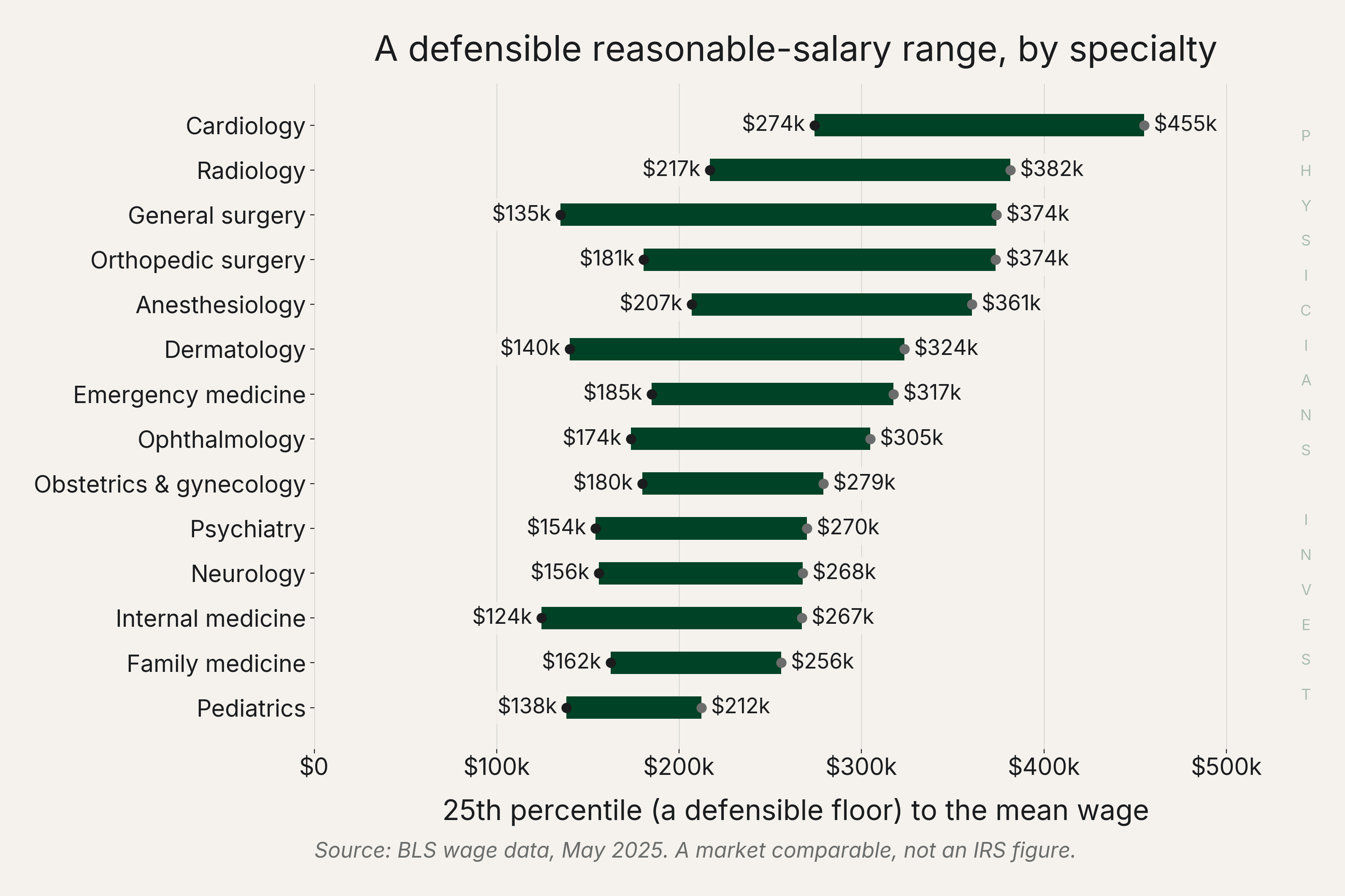 Source: BLS wage data, May 2025. A market comparable, not an IRS figure.
-
Put your family on payroll. A spouse doing verifiable work in the business can be covered by the same solo 401(k), which effectively doubles your household's sheltering room. You can also pay your kids a reasonable wage for legitimate work and that earned income can fund a Roth IRA in their name, decades ahead of the schedule most kids are on. Keep it verifiable and documented and these avenues open up.
-
Stack a cash-balance plan. For a steady, high earner who is 45 or older, a cash-balance plan bolts an additional $100,000 to $290,000 or more of shelter on top of the solo 401(k). It is age-based, so the older you are, the more you can put in. It needs an actuary and a multi-year commitment, which is why it is last on the list and not first. These can be complex so please find someone qualified to help set all of this up. Do not worry about cash-balance plans if you are a younger physician.
If you're a W-2 doctor moonlighting on 1099: most all of this list still applies to your 1099 income but a few things to note. You may have already maxed the $184,500 Social Security wage base at your W-2 day job, which is good news because you won't owe that. Also, your W-2 401(k) contributions eat into what you can defer to a solo 401(k).
The Move. Start working through this list. The land of 1099 tax advantages is not the easiest one to navigate so take small bites at a time. Pick a focus for a few months, do deep research and find good service providers, build systems to automate recordkeeping and deadline monitoring, and then move to the next tax benefit. A list below of places you could start:
- Open a solo 401(k) with the mega backdoor Roth.
- Get on an HSA-eligible plan and open an HSA.
- Work with your CPA to get accurate estimates of quarterly payments and due dates.
- Build your deduction checklist and build solid records of receipts and purposes.
- Once income is high and steady (as a rough rule of thumb, around $100k+ in net income), consider the S-corp business structure.
Sources
Policy
- IRS -- 401(k) and retirement plan limits for 2026 (IR-2025-111) -- $24,500 employee deferral limit
- IRS Notice 2025-67 -- 2026 retirement plan cost-of-living adjustments -- $72,000/$80,000/$83,250 solo 401(k) shelter, $290,000 cash-balance/DB max
- IRS -- Self-Employment Tax (Social Security and Medicare Taxes)
- IRS -- S Corporation Compensation and Medical Insurance Issues -- reasonable-salary requirement
- IRS -- Simplified option for the home office deduction -- $1,500 simplified-method cap
- IRS -- 2026 standard mileage rate -- deductible mileage
- IRS -- 2026 Form 1040-ES -- quarterly due dates and 110% safe-harbor rule
- SSA -- 2026 Social Security wage base press release -- $184,500 wage base
- Rev. Proc. 2025-32 analysis -- 2026 QBI/SSTB thresholds -- $553,500 MFJ QBI phase-out
- Rev. Proc. 2025-19 -- 2026 HSA contribution limits (via Thomson Reuters) -- $4,400/$8,750 HSA limits
Data
- BLS -- Occupational Employment and Wage Statistics, May 2025 -- reasonable-salary anchor by specialty (a market comparable, not an IRS figure)
- Emparion -- Defined Benefit / Cash Balance Plan Contribution Limits -- $100,000-$290,000+ cash-balance shelter range
Analysis
- Tax Foundation -- Section 199A and the One Big Beautiful Bill
- White Coat Investor -- SEP-IRA vs. Solo 401(k) -- pro-rata trap
- Anders CPA -- 1099 Physician Tax Deductions -- physician-specific expense list
- healthinsurance.org -- Self-Employed Health Insurance Deduction
Case Law (illustrative only, not IRS-endorsed salary figures)
- Journal of Accountancy -- Watson v. United States (8th Cir. 2012) -- token salary reclassified, cautionary example
- Bradford Tax Institute -- Sean McAlary Ltd. v. Commissioner, T.C. Summary Op. 2013-62 -- non-precedential Summary Opinion; Tax Court set a market-anchored salary below the IRS's own expert figure
Related from Physicians Invest
- W-2 Physician Tax Breaks
- 7 Side Gigs for Physicians, and Why Tax Breaks Often Beat the Extra Cash
- The Backdoor Roth IRA: What It Is, When to Use It, and Traps to Avoid
Off the Clock

What We're Reading: The Tax and Legal Playbook by Mark J. Kohler. Kohler is both a CPA and an attorney, which is exactly why we like learning from him on the entity and reasonable-salary calls in this issue. This book reads easier than a textbook, and it stays out of the weeds without dumbing anything down. If you run any kind of 1099 income, it earns its spot on the shelf.